Contract Intake Design for In-House Legal Teams
Structured intake design prevents legal chaos and lets AI tools actually work effectively.

Contract intake is the front door of every legal department, and most of them leave that door propped open with a Slack channel and a shared inbox. Effective intake design structures how requests enter the legal function so that each one arrives with the right data, lands with the right person, and connects to the right workflow before anyone has to think about it. Get this wrong, and every tool built on top of it, AI or otherwise, just automates the chaos faster.
What broken intake looks like in practice
Requests show up wherever they show up. Email, a Slack DM, a ServiceNow ticket someone filed because IT told them to, a hallway conversation that turns into a verbal commitment nobody wrote down. There is no single record of what's open, who owns it, or when it's due, so the first job on any given request is reconstructing basic facts that should have existed from the start.
The missing context is what actually kills productivity. A form, or the absence of one, doesn't ask whether IP indemnification applies, doesn't flag who the real decision-maker is, doesn't pin down the deadline versus the "would be nice" date. Those questions go unasked at intake and surface three days into drafting, and by then the work has to be redone. Unstructured intake means legal can't enforce consistency, can't route automatically, and can't see the pipeline as a whole. It just reacts, over and over, to problems that a form could have caught on day one.
The costs compound from there. Rework, missed deadlines, business partners who start routing around legal because it's faster, attorneys burned out from switching between playing detective and doing actual legal analysis. There's a quieter cost too: without structured intake data, legal has no way to show volume, turnaround time, or where its hours actually go. That absence makes budget and headcount conversations nearly impossible to win, because there's nothing to point to when finance asks for evidence.
Adoption of AI tools inside legal departments is already widespread, which makes the underlying process gap more dangerous, not less. Summize's Legal Disruptors report found 89% of in-house legal professionals use some form of AI tool, but only 42% use multiple tools consistently. Tools get adopted faster than the process that should support them, and an AI layer sitting on top of unstructured intake just produces faster inconsistency. Thomson Reuters data cited in the same Summize research found 79% of legal teams report rising contract volume, but only a third see headcount grow to match. When volume climbs and staffing doesn't, structured intake becomes the one lever legal can still pull, because it's the one variable still under its own control.
The five functional requirements any intake design must satisfy
Treat these as outcomes, not software features. A platform can check every box on a vendor's feature list and still fail if it doesn't produce these five things in practice, and most vendor demos are built specifically to obscure that gap.
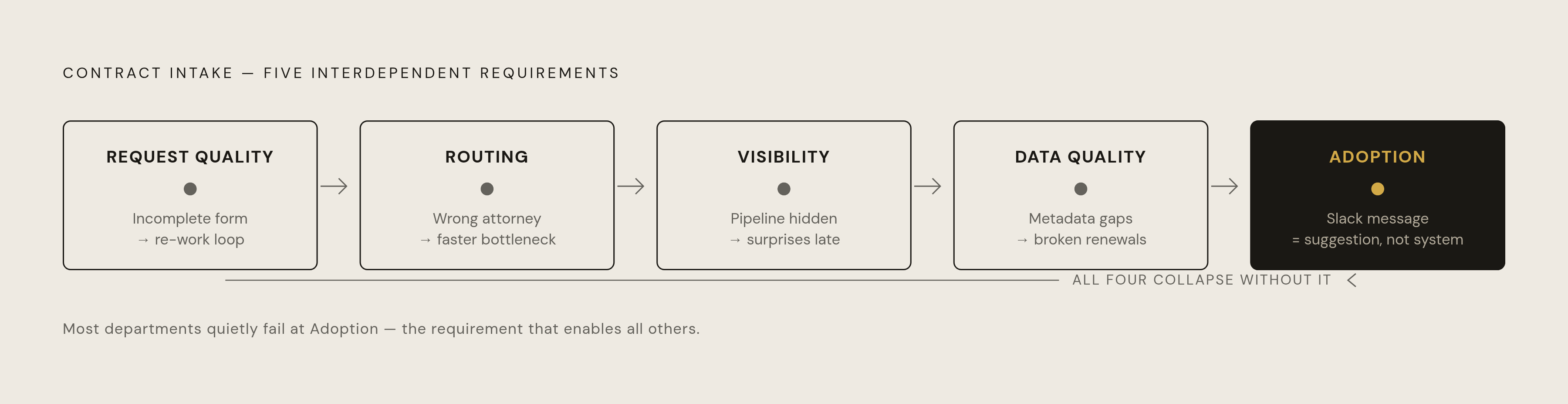
Request quality means the business gets it right the first time: no follow-up email chasing information the form should have collected. Routing means the request reaches the correct attorney or workflow automatically, based on rules defined in advance rather than someone eyeballing a shared inbox and guessing. Visibility means legal can see, at a glance, what's open, what's blocked, and what's about to miss a deadline, across the whole pipeline rather than one inbox at a time.
Data quality means the fields captured at intake turn into usable metadata that follows the contract through drafting, approval, and renewal, rather than sitting inert in a form nobody opens again. Adoption means people actually use the system, and this is the requirement most departments quietly fail. A workflow that gets bypassed by a Slack message the moment someone's in a hurry is a suggestion. It's a suggestion, and suggestions don't produce data.
These five depend on each other in ways that punish half-measures. A form with excellent fields and no adoption produces no data. A system everyone loves using but with weak routing logic just creates a faster, better-documented bottleneck, which is arguably worse because it feels like progress. Before evaluating any specific tool, a legal team should be able to say, in plain terms, whether its current process delivers on all five. Most can't, and that's the actual starting point for any intake redesign, not the vendor bake-off.
Designing intake forms that collect useful data
A contract intake form is not a generic help-desk ticket with the word "legal" bolted on. Done right, it captures the who, what, why, when, and risk profile of a request before anyone on the legal team has even opened it.
Start by mapping request types to where they actually need to go. Not every contract follows the same path: some are safe for self-service, some need internal counsel, some require outside counsel, some need sign-off from finance or security. The form should reflect those paths directly rather than sorting requests into vague buckets like "Contract Review" or "Legal Advice," categories that tell an attorney almost nothing about what's actually coming their way. An NDA intake form and a high-value customer agreement intake form should look like two different instruments, because they are, and treating them as interchangeable is the single most common design mistake in this space.
Build for volume first. NDAs, vendor reviews, and amendments are usually the highest-frequency request types in any department, so intake for those should get designed before anyone touches the long tail of edge cases. Required fields should include counterparty name, deal value, deadline, requesting department, and contract type, and anywhere consistency matters, a dropdown beats a free-text box every time. Contract type, jurisdiction, business unit: these should never get typed in by hand, because free text is where routing logic goes to die. Conditional logic earns its keep here too. Fields about data processing terms should appear only when the contract actually involves personal data, rather than cluttering every form regardless of relevance.
The test for any field on the form is simple: will it get used again downstream, in drafting, approval, storage, or renewal tracking? If the answer's no, cut it. A form is the first node in a connected system, and every field that survives onto it should be pulling weight later. The mistake to avoid is building one universal form to cover every request type. It looks efficient on paper, but in practice it frustrates every requester and produces accurate data for none of them.
Routing logic: how requests find the right person without manual triage
Intake design either pays off here or falls apart here. The best-built form in the world is wasted if every submission still lands in a shared inbox for a human to sort by hand, which is what happens at most departments that stopped their redesign at the form.
Rules-based routing means the fields captured at intake, contract type, deal value, business unit, urgency, jurisdiction, fire routing rules automatically and send the request to the right attorney or workflow without anyone touching it manually. A practical routing map, worked out on paper before any tool gets configured, might look something like this: commercial contracts go to commercial counsel, employment matters go to HR counsel, high-risk employment disputes escalate to outside counsel through a spend management integration, standard NDAs under a set value threshold go straight to a self-service path with no attorney involved, and international matters route to a designated regional lead.
AI adds a layer that pure rules-based logic can't reach on its own. Platforms with AI classification can read what a submission actually says, not just which category a requester checked, and route accordingly. Requesters misclassify their own submissions constantly because they genuinely don't know which bucket their request belongs in. AI-driven routing can also carry a request through subsequent approval steps automatically once the initial assignment is made, instead of stopping cold at the handoff and waiting for someone to notice.
No-code conditional rules matter here too, because legal teams that need engineering support every time they want to adjust a routing rule will simply stop adjusting them. The logic has to be something legal owns and edits directly as the business changes, not something locked behind a ticket to IT. Get the routing right and the payoff is concrete: fewer dropped requests, no manual triage bottleneck, and clear ownership the moment something gets submitted.
Self-service thresholds: deciding which requests should never reach a lawyer
Self-service means legal does the engineering work up front, building the guardrails once, so routine agreements execute safely without an attorney spending time on each individual instance. The judgment call that matters here is drawing the line correctly, and most departments draw it too conservatively out of habit, not risk analysis. It's drawing the line correctly, and most departments draw it too conservatively out of habit, not risk analysis.
Standard NDAs, routine vendor agreements, employment offer letters, and simple license renewals below a set value threshold are the typical candidates, because a pre-approved template with conditional logic is measurably safer and faster than a review queue once the agreement type is standardized enough. Anything with non-standard terms, high deal value, cross-border complexity, or a risk profile legal hasn't seen before does not belong in self-service, no matter how tempting the efficiency gain looks on a slide.
In practice, self-service works like this: a business user picks a contract type, the intake form captures the key variables, conditional logic assembles the agreement from a pre-approved clause library, an automated workflow routes it for whatever sign-off is required, and the contract executes without ever touching a legal review queue. Attorney judgment gets reserved for the requests that actually need it. In-house counsel is widely reported to run significantly less expensive per hour than outside counsel for routine work, and self-service pushes that cost curve down further by removing attorney time from cases that never needed a lawyer's eyes.
None of that works if the self-service portal is harder to use than typing a message to someone in Slack. If it demands a separate login or a training session, business teams bypass it within a month, and legal ends up back where it started, fielding walk-ups. Self-service also isn't something to configure once and forget. As business risk profiles shift and regulatory requirements change, legal has to revisit which agreement types still belong in that category and which have quietly outgrown it.
Multi-channel intake: meeting requesters where they already work
Adoption fails for a predictable reason: when intake requires someone to log into a legal portal they open twice a year, they don't open it. They send a direct message instead, and the pattern gets worse as the organization gets bigger and change management gets harder to steer.
The fix is to bring intake to the tools people already live in, not to build a better portal and hope habits change. Slack, Microsoft Teams, Salesforce integrations matter because submitting a contract request should feel like sending a message, not filling out a government form in triplicate.
Two philosophies compete here, and they trade off against each other directly. Form-first intake uses a structured portal that walks the requester through every required field, which produces high data quality but only works if people actually show up to use it. Conversational, AI-native intake captures the request in natural language, wherever the requester already is, and lets AI structure the data behind the scenes. Sandstone is an AI-native legal department platform built around this model, capturing requests across Slack, email, and existing tools without a separate portal or login. It drives adoption because there's no new habit to build, but it pushes more of the burden onto the AI classification layer to extract clean, consistent fields from language that was never designed to be structured.
Neither approach wins. The right choice depends on the organization's size, its existing tool stack, and how much change management the team can realistically absorb. Good intake design proves itself by whether business teams are still using it six months in, not by how good it looks in a demo. The broader direction in the space points toward trusted AI agents embedded directly into tools people already use, Outlook, Gmail, Salesforce, SharePoint, so contract intake becomes a native part of the workday rather than a separate destination employees have to remember exists.
Connecting intake to the contract lifecycle so data flows forward
Intake in one system, matter management in a second, contract storage in a third: that's how data gets re-entered by hand at every handoff, how errors multiply, and how the audit trail quietly breaks somewhere in the middle. Nobody notices until a renewal date gets missed or a dispute needs a document that was never properly filed.
Integration has to be a design principle from day one. Before a single field goes on an intake form, the team needs to know what has to flow into the CLM, what the matter management system expects to receive, and what data the approval workflow needs in order to fire correctly. Xakia's model shows what the integrated version looks like: when someone submits an intake request, that submission is the matter. There's no separate system to re-enter it into and no duplicate record to reconcile later.
Done well, the data captured at intake does real work downstream. It drives template selection and clause population during drafting. Deal value and contract type from the intake form trigger the correct approval chain automatically. Counterparty name, renewal date, and jurisdiction, captured once at the start, become the metadata that fires renewal alerts months or years later. Volume by contract type, turnaround time by department, SLA adherence: all of it derives from intake data that was structured correctly from the first submission, not reconstructed after the fact.
CLM platforms are moving toward AI-first contract hubs with intelligent clause extraction and autonomous contracting agents, but that evolution only pays off if intake feeds it clean data to begin with. Garbage entering at the front door causes garbage to propagate through every downstream automation, no matter how sophisticated the CLM gets. The real test for any integration is straightforward: if intake still requires someone to manually key data into a downstream system, the integration hasn't actually been built. It's just been described in a sales deck.
AI's role in intake triage, classification, and agentic routing in 2026
The experimentation phase is over. The 2026 CLOC State of the Industry Report found 80% of legal teams prioritizing technology strategy, with 85% maintaining dedicated AI resources focused specifically on deployment, governance, and risk management, infrastructure rather than a pilot program someone can quietly shelve. That distinction matters when evaluating long-term investment in intake design.
Inside intake specifically, AI does three concrete things. It classifies requests by reading the actual content of a submission and correctly categorizing it even when the requester picked the wrong option from the dropdown. It triages by priority, flagging urgency based on the language used, how close the deadline is, or signals about deal value buried in the submission text. And it enables agentic routing, where a chain of steps executes without a human approving each one individually: intake triggers classification, classification triggers routing, routing triggers drafting or template assembly, all in sequence, without a human touching the handoff.
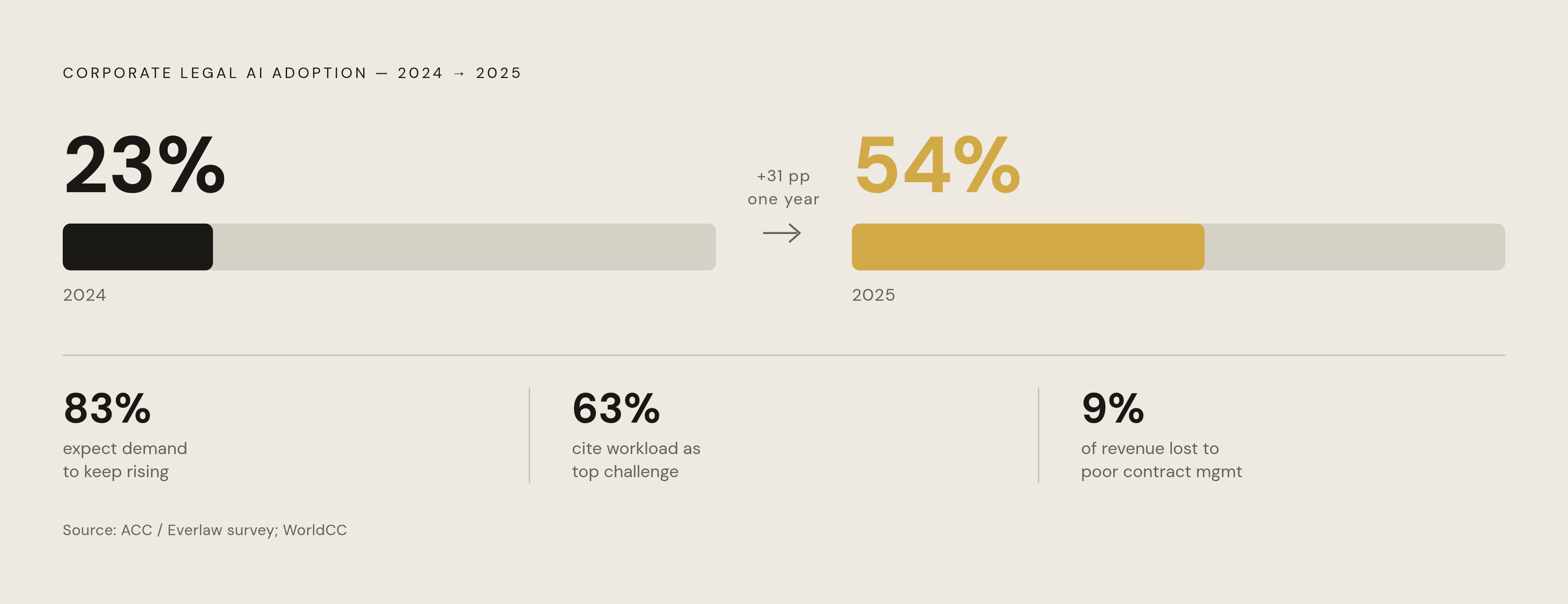
Adoption numbers back up how fast this shifted. Corporate legal AI adoption more than doubled in a single year, from 23% in 2024 to 54% in 2025, an ACC and Everlaw survey found. That's a department-wide phase change, not a gradual curve, and it lines up with the underlying math CLOC's research already laid out: 83% of legal departments expect demand to keep climbing, 63% cite workload and bandwidth as their top challenge, and managing contracts alone can consume a substantial share of a legal department's total capacity. WorldCC research puts the cost of poor contract management as high as 9% of annual revenue for an organization, which reframes intake from an administrative inconvenience into a genuine balance-sheet risk.
None of the AI layered on top of intake fixes anything if the underlying structure is still broken, and this is the point most departments skip past on their way to buying a tool. Classification only works on submissions that carry enough structured signal to classify. Routing only works if the rules it's executing were actually mapped out with intention beforehand. Agentic workflows only chain together correctly if each step was designed to hand off cleanly to the next one. The technology has clearly arrived. Whether it delivers depends entirely on whether the front door it's walking through was ever built to let the right data in.