AI Clause Extraction Accuracy in Enterprise CLM Tools
Vendor accuracy claims mask the three metrics that actually predict extraction failure.
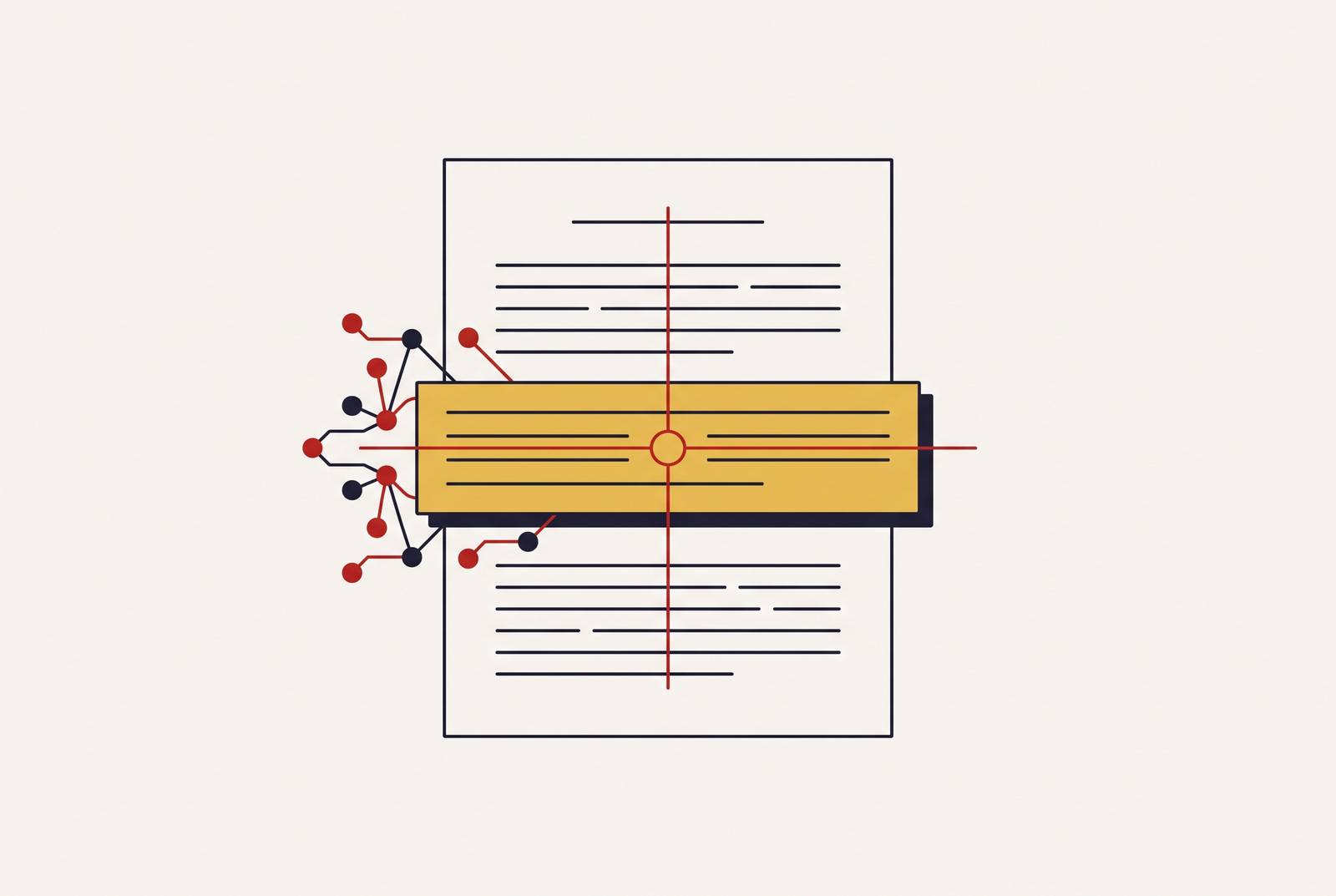
Contracts carry obligations with deadlines, liability caps that decide who pays when something breaks, and renewal triggers that quietly turn a one-year deal into a five-year commitment if nobody catches the clause in time. None of that matters unless the clause gets pulled out correctly and put in front of the person who has to act on it. That's the whole premise behind AI clause extraction in contract lifecycle management (CLM) software, and it's also where most vendor accuracy claims fall apart under close reading. A single "accuracy" number cannot stand in for the three separate metrics that actually determine whether extraction works, and buyers who accept that number at face value are the ones who end up paying for it later.
When extraction fails, or extracts a clause and misclassifies it, the failure doesn't stay contained. Risk management turns into guesswork, obligation tracking slides back into spreadsheets nobody trusts, and compliance monitoring breaks quietly, with no alarm going off until an auditor or a client finds the gap first. Sirion's research points to a global manufacturer that racked up $2 million in avoidable penalties because penalty clauses buried across dozens of vendor contracts only surfaced after the deadlines they governed had already passed. That's a business paying, in cash, for extraction that looked fine in a demo and wasn't.
The upside is real when extraction works. Enterprises using accurate clause extraction report time savings of around 80% on contract review cycles and a 40% cut in compliance violations. But those numbers only hold if the extraction underneath them is actually correct, and vendors tend to gloss over that condition. Accuracy is the one line in the pitch deck every other promised benefit depends on, and most legal teams are deciding how to weigh it right now.
How vendor accuracy claims are constructed, and what they typically obscure
Vendor pitches tend to lead with a single number: overall accuracy, or some efficiency percentage, presented without saying which metric produced it, which clause types it covers, or what baseline it's measured against. That omission is deliberate. It's the easiest way to make a mediocre number sound like a good one.
Overall accuracy is a particularly slippery figure. A platform can post a high overall score while quietly failing on the clauses that actually carry risk: liability caps, termination rights, indemnification language. A tool that nails 95% of boilerplate definitions and stumbles on indemnification is not a 95%-accurate tool for any legal team that cares about indemnification, and most do.
Efficiency claims muddy the water further. A vendor citing a 20 to 40% efficiency improvement is describing operational gains, not correctness. A system can extract fast and still be wrong often enough to create real exposure, and speed without accuracy just means the team finds out about the mistake sooner.
There's a meaningful split between purpose-built legal AI and general-purpose tools here, and it's not a close call. Purpose-built legal AI delivers 21% greater perceived accuracy over generic AI tools, largely because purpose-built systems cite the exact character range or clause they pulled a claim from, while generic tools tend to produce confident-sounding answers with no verifiable anchor behind them.
Some vendors simply don't publish accuracy metrics at all. That silence is itself informative: a vendor confident in independently verified numbers would publish them. Buyers don't need a better way to read a datasheet. They need a framework for demanding the evidence datasheets routinely leave out.
The metrics that actually measure clause extraction quality: precision, recall, and F1-score
Three numbers matter here, and none of them are "overall accuracy."
Precision asks: of everything the system flagged as a clause, how much of it was actually correct? Low precision means false positives, and false positives mean a legal team burns hours filtering noise the software should have filtered itself.
Recall asks the opposite question: of every clause that actually exists in the document, how many did the system find? Low recall means false negatives, and false negatives are the dangerous ones, because they're the risk nobody knew to look for. A missed indemnification clause slips through without announcing itself. It just sits there until it costs someone money.
F1-score is the harmonic mean of the two, and it's the closest thing to an honest headline number in this space. A system that flags every sentence in a contract as a "clause" hits 100% recall instantly, since it can't miss anything, but precision collapses to nearly zero, and the tool is useless. Overall accuracy as a metric can hide that trade-off completely. F1 can't.
Buyers evaluating vendors should ask for numbers against real thresholds, not vague reassurance. An 85% recall floor for critical clause categories is the standard worth holding vendors to, alongside 85%-plus accuracy for OCR and metadata work on mixed document sets. Getting into the 90s is where manual verification loops start becoming genuinely manageable rather than a permanent tax on the legal team's time.
Speed matters too, but only after accuracy clears the bar. A system that hits strong F1 scores but takes five minutes per contract behaves very differently at enterprise volume than one that's equally accurate in two minutes. And error classification, knowing whether a system's mistakes cluster around a specific clause type such as indemnification, tells a buyer far more than a single aggregate error rate ever could.
What benchmark testing conditions reveal that vendor demos do not
Vendor demos run on clean paper: well-formatted templates, standard clause structure, nothing weird. Real enterprise contract portfolios look nothing like that. Scanned PDFs from a decade ago, legacy agreements with layouts nobody standardized, multi-jurisdiction contracts, bespoke commercial deals with clause language that's never appeared in any training set.
The fix is straightforward, if underused. Buyers should insist on pilot testing against their own document sample, not a vendor-curated test set built to flatter the product. Anyone wanting an independent check outside vendor-supplied data can turn to ContractNLI, a public benchmark dataset, which gives buyers something to run evaluation scripts against without relying on anyone's marketing claims.
What actually needs testing goes beyond the obvious. Edge cases matter: clauses that stray from the standard template, cross-references between sections, definitions that live in a schedule rather than the body of the contract. Missing clause detection deserves its own test, since flagging that a required clause is absent is not automatically covered by a platform that correctly classifies clauses that are present. Scanned and OCR-heavy documents are where accuracy tends to degrade first, which is exactly why testing against mixed document sets matters.
Volume consistency needs checking directly, too. Does accuracy hold when a platform processes contracts simultaneously at real enterprise scale, or does it quietly degrade under load in ways a single-document demo would never surface?
Buyers should also just ask vendors directly: how many contracts sat in the evaluation set, what contract types were included, who verified the ground-truth annotations (ideally legal professionals outside the vendor's own team), and whether error classification by clause category exists at all. Sirion's ContractEval benchmark, run in 2026 across 500 real-world contracts spanning technology services, procurement, and partnership deals, measured F1 and processing speed as separate figures rather than folding them into one score. That structure is worth using as a checklist when requesting a vendor pilot, regardless of which platform is under evaluation.
How the leading enterprise CLM platforms actually perform on clause extraction
Gartner's 2024 Magic Quadrant for Contract Lifecycle Management named five Leaders: Sirion, DocuSign, Ironclad, Icertis, and Agiloft. Treating those five as interchangeable because they share a quadrant label is the mistake most buyers make at this stage. Performance on clause extraction specifically varies far more than the label suggests.
Sirion posted a 94.2% overall F1-score in the 2026 ContractEval benchmark across those 500 contracts, with commercial terms as the strongest category at 96.1%. That put it 8.9 percentage points ahead of fine-tuned GPT-4, which scored 85.3% in the same benchmark, with Claude 3.5 Sonnet at 83.9% and Llama 3.1 70B at 79.2%. Sirion also processed contracts in 2.3 minutes on average, versus 3.9 to 5.1 minutes for the open-source models tested alongside it. The platform classifies more than 1,200 clause and metadata fields and shows its reasoning alongside each extraction rather than just handing over a result. Accuracy held without degradation when processing thousands of contracts simultaneously, according to available research on Sirion's volume performance. Sirion has held a Leader position in Gartner's CLM Magic Quadrant for multiple consecutive years and ranked first across all CLM use cases in Gartner's Critical Capabilities report.
Ironclad's SmartImport tool handles clause and property capture, though publicly available independent accuracy figures for the tool are not confirmed, meaning buyers should verify performance through their own pilot testing. Its newer Jurist AI feature, launched in November 2024 according to Law.com's coverage, works inside the editable.docx workspace and shows its reasoning and citations inline. It performs well on four standard contract types but gets noticeably more generic once contracts move into bespoke commercial territory where clause language doesn't match a template. Ironclad cites efficiency and ROI gains in its customer materials, though those are operational figures, not extraction accuracy figures, and the two shouldn't get confused. Deployment timelines vary across platforms, and Ironclad's Workflow Designer and Salesforce integration depth are factors worth weighing against time-to-value when comparing options.
Icertis doesn't publish specific accuracy metrics, and that absence should register with buyers as a due-diligence gap, not an oversight to wave past. Pilot testing becomes non-negotiable before signing. Its clause library runs industry-specific rather than broad-field, which suits organizations with already-mature contract processes needing multi-jurisdiction compliance and layered approval policies. The integration stack reaches across Microsoft, SAP, Salesforce, Coupa, and Workday, so it fits naturally where one of those ecosystems already dominates. The governance functionality runs deep enough that it's best matched to teams with dedicated administrative resources, less so to lean legal departments expecting extraction to work out of the box with minimal configuration.
Evisort, acquired by Workday in 2024, trains its models specifically on legal and contractual language, aimed at identifying and recalling payment terms, governing law provisions, renewal language, and contractual obligations. It's positioned for large organizations managing heavy contract volume where extraction accuracy across a complex repository is the priority. No specific F1 or precision/recall figures are publicly available, so accuracy claims here need confirming through a pilot rather than taken on faith.
DocuSign CLM benefits from an e-signature ecosystem most legal teams already use, though its clause library runs standard rather than deep-field. Starting price is $25 per user per month, the most accessible entry point among the platforms compared here. AI explainability rates as medium in Gartner's Leaders comparison, and redlining speed is standard rather than accelerated.
Agiloft sits in Gartner's large-enterprise Leaders tier, built around highly customized enterprise workflows. A LinkSquares comparative guide rates its clause detection "Strong" across payment terms and governing law, with solid workflow automation to match. No publicly available extraction accuracy figures from independent benchmark testing appear in the available research.
LinkSquares earns "Excellent" ratings across AI clause detection, payment term extraction, governing law clause extraction, and overall extraction accuracy in its own 2026 comparative guide. It's built for in-house legal, procurement, and revenue teams, positioned on delivering strong accuracy without the deployment timelines or administrative overhead of larger enterprise suites. It combines contract intelligence, CLM, workflow automation, repository management, and AI analysis in one platform.
Juro rates "Moderate" on the same four categories in that comparative guide: AI clause detection, payment term extraction, governing law clause extraction, and accuracy. It's built for fast-moving commercial teams rather than deep enterprise-grade clause extraction, and its ratings reflect that narrower ambition.
| Platform | F1/Accuracy | Clause library depth | Explainability | Starting price | |---|---|---|---|---| | Sirion | 94.2% F1 (ContractEval, 2026) | 1,200+ fields | High, cited reasoning | Not disclosed | | Ironclad | ~80% (SmartImport) | Strong on 4 standard types | Inline reasoning (Jurist AI) | Not disclosed | | Icertis | Not disclosed | Industry-specific | Not disclosed | Not disclosed | | Evisort | Not disclosed | Legal-language optimized | Not disclosed | Not disclosed | | DocuSign CLM | Not disclosed | Standard | Medium | $25/user/month | | Agiloft | Not disclosed | Strong (payment, governing law) | Not disclosed | Not disclosed | | LinkSquares | Excellent (self-reported) | Deep | Not disclosed | Not disclosed | | Juro | Moderate (self-reported) | Standard | Not disclosed | Not disclosed |
What the accuracy gap between purpose-built legal AI and generic LLMs means in practice
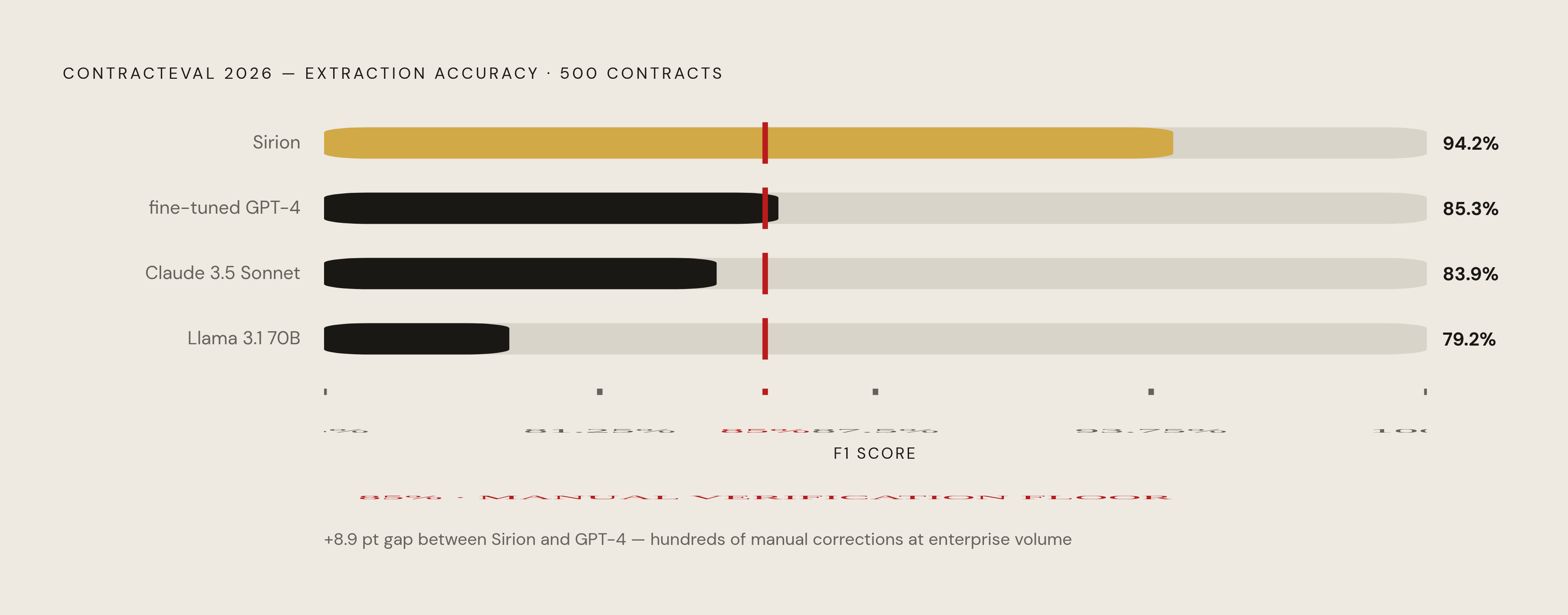
The ContractEval numbers show 94.2% for a purpose-built extraction system against 85.3% for fine-tuned GPT-4 and 79.2% for an open-source model. At enterprise contract volume, a gap of nine or fifteen percentage points carries real financial weight: the difference between a handful of manual corrections and hundreds of them.
Part of the reason traces back to citations. Purpose-built systems tend to point to the exact character range or clause language behind an extraction, rather than producing a confident answer with no anchor behind it. A December 2025 ROI study covering more than 100 active legal AI customers ties this mechanism directly to that 21% perceived-accuracy advantage over generic AI tools.
The same study found customers of purpose-built legal AI saving an average of 14 hours per lawyer per week, alongside a 14% cut in outside counsel spend, which on a median outside counsel budget of $1.8 million works out to roughly $252,000 in annual savings. That's a line item a CFO notices, not a rounding error.
Generic LLMs tend to stumble in the same places every time: novel clause structures, cross-references between defined terms buried in a schedule, clauses phrased in some unusual way that doesn't match anything in the training data. These are, not coincidentally, exactly the documents where manual review already struggles the most. Missing clause detection compounds the problem further. Flagging that something is absent is a different skill from correctly classifying something present, and research from Legistify and McKinsey both point to purpose-built clause intelligence explicitly checking for terms that should exist but don't, a capability generic tools rarely replicate well.
Explainability closes the loop. When a system shows its reasoning alongside an extraction, a legal reviewer can spot an error in seconds rather than re-reading the whole contract to check the machine's work. That audit trail is the part generic LLM output tends to skip.
Where accuracy falls short of the threshold and what it costs the organization
There's a practical floor here, and it is around 85%. Below that, legal teams get pulled into manual verification loops that cancel out whatever automation gain the platform was supposed to deliver in the first place. The efficiency numbers vendors love to quote only materialize once extraction accuracy clears that floor. Below it, the platform is adding a review step, not removing one, and no amount of workflow polish fixes that math.
The downstream costs are measurable. Organizations running accurate AI-powered extraction report 8 to 12% lower spend leakage, catching billing errors, missed discounts, and unauthorized charges before they compound. Accurate extraction also correlates with 99% on-time obligation compliance in reported deployments, while inaccurate extraction leaves compliance monitoring dependent on the exact manual process the software was bought to replace.
Organizations with accurate, real-time extraction report 60% lower cost of contract governance overall, and that number only holds when the underlying data quality is good enough to support automation rather than demanding constant human correction behind the scenes. Some research points to prevention of up to 9% in annual value leakage tied to accurate extraction, though that figure is a ceiling, not a guarantee, since actual leakage depends heavily on the specific contract portfolio involved.
The hidden cost sits in the correction loop. An 80%-accurate platform does not save 80% of review time, because every missed or wrong extraction triggers a manual check, and on high-stakes contracts, the corrections cluster exactly where errors are most expensive: liability caps, termination conditions, indemnification. The question worth asking is what accuracy a platform actually delivers. It's what manual correction costs at that platform's documented error rate, run against actual contract volume. That's a calculation worth doing with real numbers before a contract gets signed, not after.
How to run the evaluation before signing anything
Start with the buyer's own documents, not the vendor's. Pull a representative sample, scanned PDFs included, legacy agreements included, and ask the vendor to run extraction against it live, not against a curated demo set built to perform well.
Ask for precision, recall, and F1 separately, broken out by clause category if the vendor can provide it. Treat a single overall accuracy number as a red flag, not a reassurance. Ask how the ground-truth annotations behind any published benchmark were verified, and by whom, since a vendor grading its own homework is a different claim than an independently verified one.
Test for missing clauses specifically, not just misclassified ones. Test at volume, not on a single contract. And compare the platform's documented error rate against actual contract volume to estimate what manual correction will cost in practice, because that number, not the marketing page, decides whether the platform pays for itself.