CLM Implementation Failures and How to Avoid Them
Structural problems, not software limitations, cause half of first-time CLM rollouts to fail.
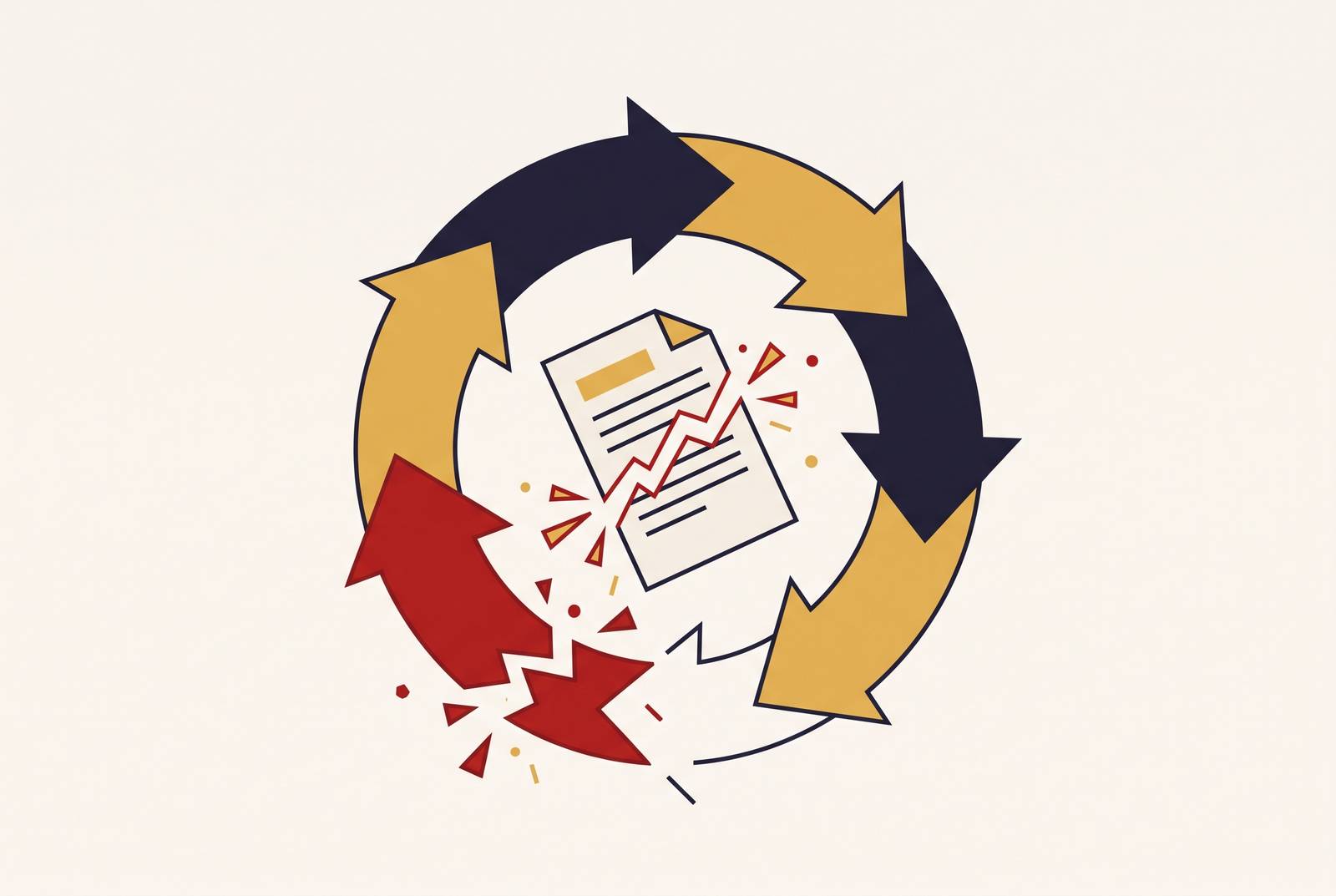
Gartner projects that half of all first-time CLM implementations fail to deliver the benefits they set out to capture. That's the median outcome, not a warning label on immature software. Most teams that attempt contract lifecycle management for the first time land on the wrong side of that number, and the reasons are structural. This piece works through why the failure rate holds steady even as the platforms get better, and what a team can do at each stage of implementation to stay out of it.
Failure at this scale doesn't stay contained. Teams burned once don't just try again with a different vendor. They carry the memory of the failed rollout into every future evaluation, and the fallback is rarely a competing platform. It's spreadsheets, shared drives, and email threads, the exact tools CLM was supposed to retire. That reversion makes the original cost worse instead of resetting it.
Poor contract management costs organizations somewhere between 5% and 9% of annual revenue. That range turns a failed implementation from an IT disappointment into a real hit to the bottom line, and it means the failure rate can't get waved off as bad luck or a market still finding its footing.
The technology is almost never the reason these projects fail. The reasons are structural: unclear objectives, stakeholders working from different assumptions, customization that outruns what a team can maintain, integrations tested too late, and adoption efforts that never get the attention given to configuration. These problems show up so consistently across implementations that they can be planned around in advance. Most of them are avoidable outright, since this is an industry where the outcomes are largely under operators' control. It's an industry where half the field skips steps it already knows about.
What a successful CLM implementation can actually deliver
Get the fundamentals right, and the returns aren't marginal. Terumo cut its contract processing time from weeks down to days. LogicMonitor recovered 4,558 hours of staff time and put estimated monthly ROI at roughly $100,000. Numbers like that come from organizations that treated implementation as a discipline, not a software purchase, and they set the baseline against which "average" performance looks genuinely disappointing.
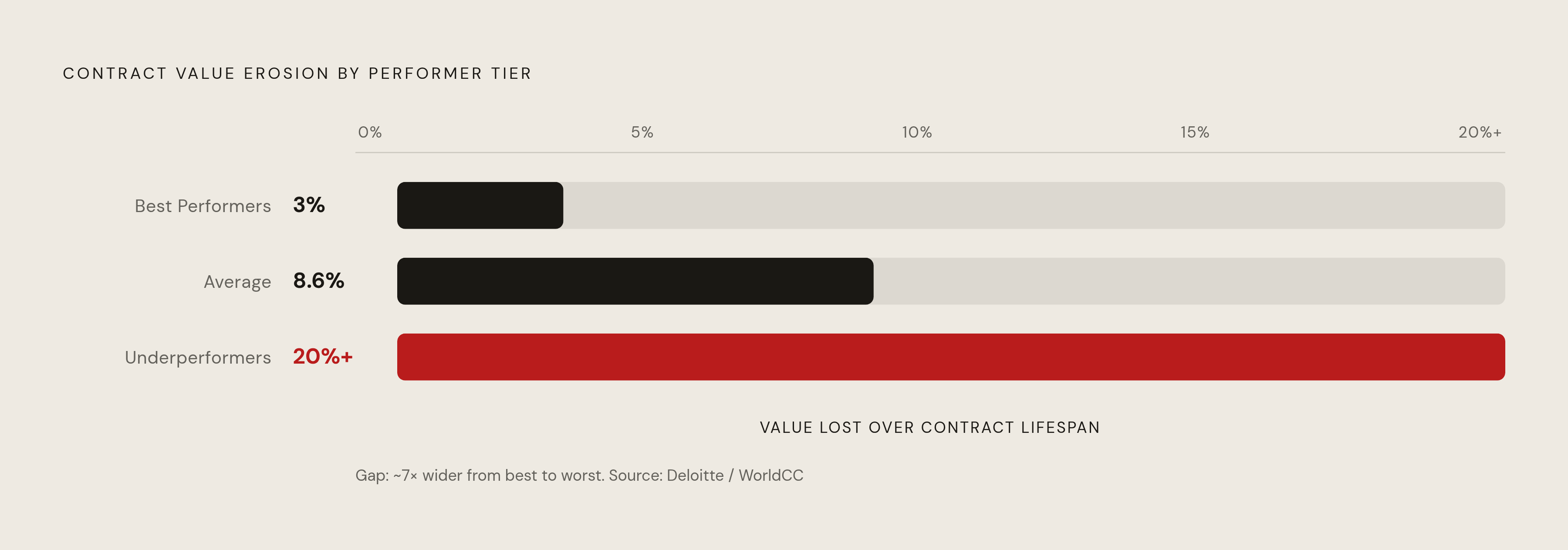
Research from Deloitte and WorldCC gives the clearest picture of what separates winners from everyone else. The average contract loses 8.6% of its value over its lifespan, through missed renewals, unenforced obligations, and terms nobody tracked. Best-performing organizations hold that erosion to about 3%. Underperformers lose more than 20%. A spread that wide, on the same underlying asset, a contract, reflects something deeper than a difference in software. It's a difference in how the organization built and ran its implementation, full stop. The rest of this piece is about closing that gap.
Strategic misalignment: starting without a coherent objective
Every downstream failure starts here. When a CLM initiative launches without objectives tied to a specific business outcome (faster deal cycles, tighter compliance, better renewal capture) it drifts. There's no yardstick, so there's no way to tell six months in whether the project is working or just running.
Get this distinction wrong and everything after it inherits the mistake: a contract repository is not full contract lifecycle management. A repository stores documents. CLM governs authoring, negotiation, approval routing, obligation tracking, and renewal, from first draft to final signature and beyond. Confuse the two and the timeline is wrong from day one, because vendor selection ends up solving a storage problem when the actual problem is a workflow problem.
Unclear objectives also invite scope creep. Without a defined target, organizations default to trying to cover every contract type and every system integration in a single push, which slows adoption and drives up long-term maintenance. Contract data, before CLM even enters the picture, is typically scattered across an average of 24 different systems inside a given organization. Pick a platform before mapping that landscape, and the implementation gets built on a foundation nobody actually understands.
Process mapping has to come before platform selection, not after. Documenting how contracts actually move through the organization, where they stall, who signs off, what breaks, isn't a preliminary courtesy. Skip it, and the project automates a broken process and runs it at scale, faster and with more confidence than it deserves. Normalization matters just as much: inconsistent templates, clause libraries, approval chains, and naming conventions across departments make automation functionally impossible, no matter how capable the platform is. That cleanup is a prerequisite, not a task to defer until after go-live.
Stakeholder misalignment and the absence of executive sponsorship
Research indicates that a large majority of organizations struggle to build agreement across stakeholders on CLM projects. That's the standard starting condition, not an edge case.
CLM touches legal, sales, procurement, finance, and IT all at once, and each group wants something different: legal wants risk contained, sales wants deals closed fast, finance wants an audit trail, IT wants something it can secure and maintain. Without a structured way to resolve those competing priorities, no single configuration satisfies anyone, and the rollout ends up as a compromise nobody actually endorsed.
One pattern deserves more of the blame than any other: IT selects the platform, and legal operations inherits the decision after the fact. IT evaluates vendors on integration architecture and security posture, which is reasonable given its mandate, but the legal and procurement staff who use the system daily were never in the room. The workflow that results gets built around IT's assumptions about how contracts move, not legal's lived reality of how they actually do. That gap alone accounts for a large share of the adoption failures that surface months later.
Executive sponsorship is the other piece that tends to go missing, and its absence rarely gets noticed until it's too late to fix cheaply. Without someone senior enough to hold departments accountable across the length of the project, priorities drift, budget gets reallocated to whatever's louder that quarter, and adoption targets quietly fall off the agenda. A steering group, drawing named representatives from Legal, Sales Ops, Procurement, Finance, and IT, is the mechanism that keeps decisions moving. It's what keeps the implementation from becoming one department's burden that everyone else ignores until it fails.
Overcustomization and how it becomes a trap
Early-generation CLM platforms sold themselves on configurability, and in practice that configurability often meant custom code. Every workflow tweak, every new approval branch, every template revision required a vendor statement of work and weeks of lead time before it shipped.
Business processes evolve faster than that. When the platform can't keep pace, teams stop fighting it and go back to whatever they can control directly, which usually means email and spreadsheets again. That's the normal failure sequence, not the exception.
A 2022 Onit survey found that 77% of in-house counsel had lived through a failed legal technology implementation. The most commonly cited factor was lengthy rollout processes, at 38%, alongside solutions that had grown too complicated to manage. Overcustomization carries a second cost that shows up later: every bespoke automation built before there's real usage data to justify it becomes a maintenance liability the moment the vendor pushes an update or the organization reorganizes its workflows.
Scope-locking is the discipline that prevents this, and it belongs in the non-negotiable column, not the aspirational one. Define the minimum implementation that delivers measurable value, launch it, and defer anything bespoke until actual post-go-live data says it's worth building. Resist the instinct to build now for requirements someone imagines the organization might have in eighteen months. Newer, agentic CLM platforms with no-code configuration and pre-built workflow templates make this easier to pull off technically, but the underlying discipline of restraint holds regardless of which platform sits underneath.
Integration failures and data migration problems that only appear after go-live
A CLM platform that can't talk cleanly to the CRM, the ERP, and whatever e-signature tool the organization already runs creates exactly the data silos and manual workarounds the implementation was supposed to eliminate. Contract review that happens outside the platform, in email threads or downloaded Word documents, does more than annoy users. It fragments the data and quietly undermines the visibility and governance case that justified the spend in the first place.
Industry research flags complex stakeholder collaboration as a major recurring obstacle, and the reason is structural: many CLM systems get built primarily around legal's workflow assumptions, which leaves sales, procurement, and finance staff navigating an interface designed for someone else's job when they need to review or edit a document themselves.
Data migration problems follow the same pattern of showing up late, and this is where most timelines quietly slip. Contracts scattered across old emails, shared drives, spreadsheets, and legacy databases carry incomplete metadata, duplicate entries, and fields that don't line up cleanly. None of that tends to surface in testing. It surfaces when real users start working inside the live system under real deadlines, which is the worst possible moment to discover it. Scheduled audits after migration aren't a nice-to-have; they're the only reliable way to catch what testing missed. Integration capability belongs in the vendor evaluation itself, assessed alongside end-to-end automation and governance controls, not treated as a technical detail to sort out after the contract's signed.
The adoption problem: why technology capability and actual usage diverge
Every failure mode above eventually resolves into the same question: does anyone actually use the thing? A platform with sophisticated AI, deep integrations, and a strong security posture returns exactly zero if the legal team routes around it.
Aberdeen research puts the share of legal departments still operating without any automated contract management software at 60%, which suggests the industry's real adoption baseline sits well below what the market's investment figures might imply. Broader research into organizational change backs this up: research shows up to 70% of change initiatives fail because of poor focus on people and process, not technology. CLM implementations aren't an exception to that pattern, and treating them as a pure technology rollout is exactly how they end up joining it.
Enterprise software that's hard to use simply doesn't get used. If a legal team faces a clunky interface, too many clicks to complete a routine task, or training requirements for something that should be intuitive, they'll find a workaround. Go-live support is where most organizations underinvest most severely: without a named administrator or a managed partner in place to handle troubleshooting, refine workflows, and keep training current, frustration builds and adoption stalls before the system ever reaches the capability it was purchased for. The absence of structured change management (stakeholder alignment carried through past go-live, role-specific training, clear communication about what's actually changing) is one of the most consistent contributors to CLM abandonment across the industry.
A phased implementation approach that limits exposure at each stage
For any organization of real size, a phased rollout beats a big-bang deployment on nearly every measure, and the industry's own data backs the sequencing up. Start with the priority contract types, a single department, or one region, refine the workflows and integrations against real usage, and scale from there once the fundamentals hold. A big-bang deployment, by contrast, multiplies every failure mode above at once: unclear objectives, unresolved stakeholder disputes, and untested integrations all surface simultaneously, on the same go-live date, with no smaller failure to learn from first.
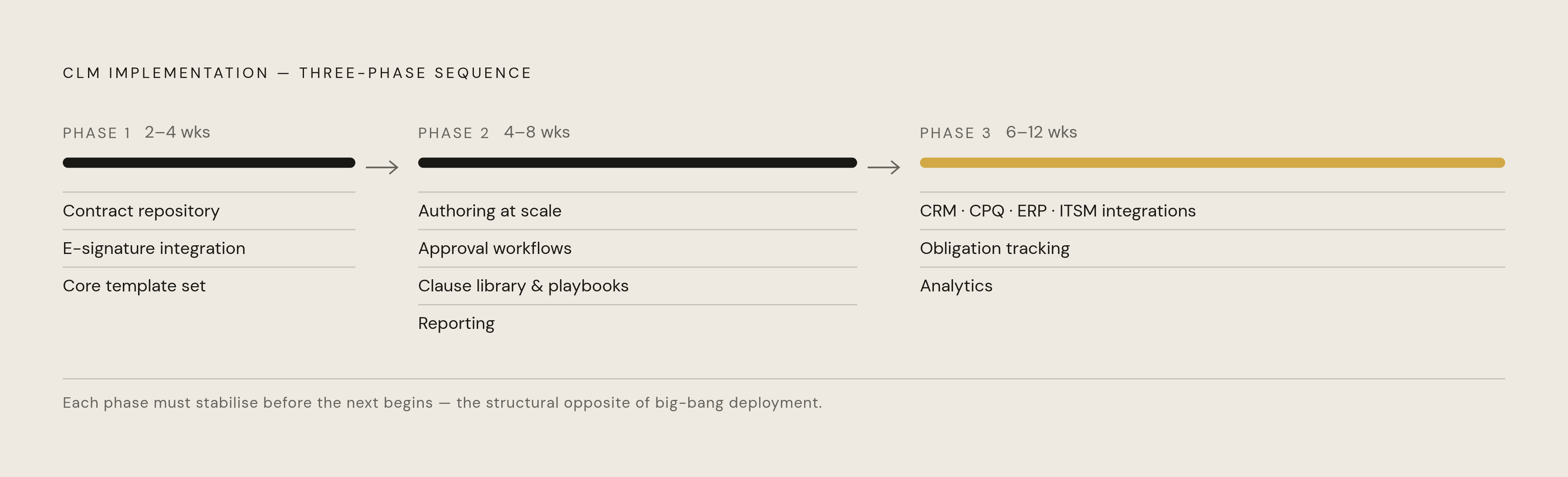
Juro's 2024 implementation survey found the most common CLM rollout timeframe runs two to four months, though that average hides a wide range: basic repository setups can go live in under a day, while complex enterprise deployments stretch past twelve months. A practical three-phase structure, drawn from implementation guidance across the industry, breaks down like this. Phase one, two to four weeks, covers the contract repository, e-signature integration, and a small set of templates, enough to deliver a measurable cycle-time improvement quickly and build user confidence early. Phase two, four to eight weeks, adds authoring at scale, approval workflows, a clause library, playbooks, and reporting. Phase three, six to twelve weeks, layers in deeper integrations with CRM, CPQ, ERP, and ITSM systems, along with obligation tracking and analytics.
For organizations that have already been through a failed CLM attempt, a four-to-six week proof of concept, scoped tightly to one workflow and one team, is the lowest-risk way back in. Lock the scope early, timebox anything optional, and hold off on bespoke automation until data from actual use justifies it. A single RACI chart, disciplined promotion from sandbox to production, a weekly cadence of user acceptance testing, and training built around the live workflow rather than a hypothetical one all cut risk measurably at each stage.
Governance, KPIs, and how to sustain adoption after go-live
Digital transformation without metrics is just spending. KPIs need defining before go-live, not invented afterward to justify the project, and they need tracking on a fixed cadence: contract cycle time, approval lag, automation rate, compliance rate, and renewal ratio all belong on that list.
That tracking does two things at once. It surfaces workflow problems early enough that they can still be fixed cheaply, and it builds the evidence base that keeps executive sponsorship alive once the project stops being new and starts being routine, which is exactly the point where attention typically fades.
The cross-functional steering group shouldn't disband the moment the system goes live. Continued representation from Legal, Sales Ops, Procurement, Finance, and IT is what catches the integration failures and migration gaps that only show up under real usage conditions, weeks or months after launch. Governance now also has to reckon with AI directly: AI oversight has become a standing item on the executive agenda rather than an afterthought, and organizations running AI across contract workflows answer for traceability, fairness, and explainability in whatever decisions that AI makes. A governance framework built only around workflow configuration, with nothing to say about model behavior, is already out of date.
The performance gap described earlier bears repeating, because it's the clearest evidence available that discipline, not platform choice, decides the outcome. Best performers hold contract value erosion to about 3%. The average organization sits at 8.6%. Underperformers lose more than 20%. Naming a CLM administrator or managed partner, someone accountable for troubleshooting, workflow refinement, and ongoing training after the implementation team moves on to the next project, is the piece of infrastructure that keeps adoption from quietly stalling once the initial momentum runs out.