Negotiating SLA Remedies That Actually Compensate for Downtime
Standard SLA credits cap vendor liability, not compensate actual downtime costs.
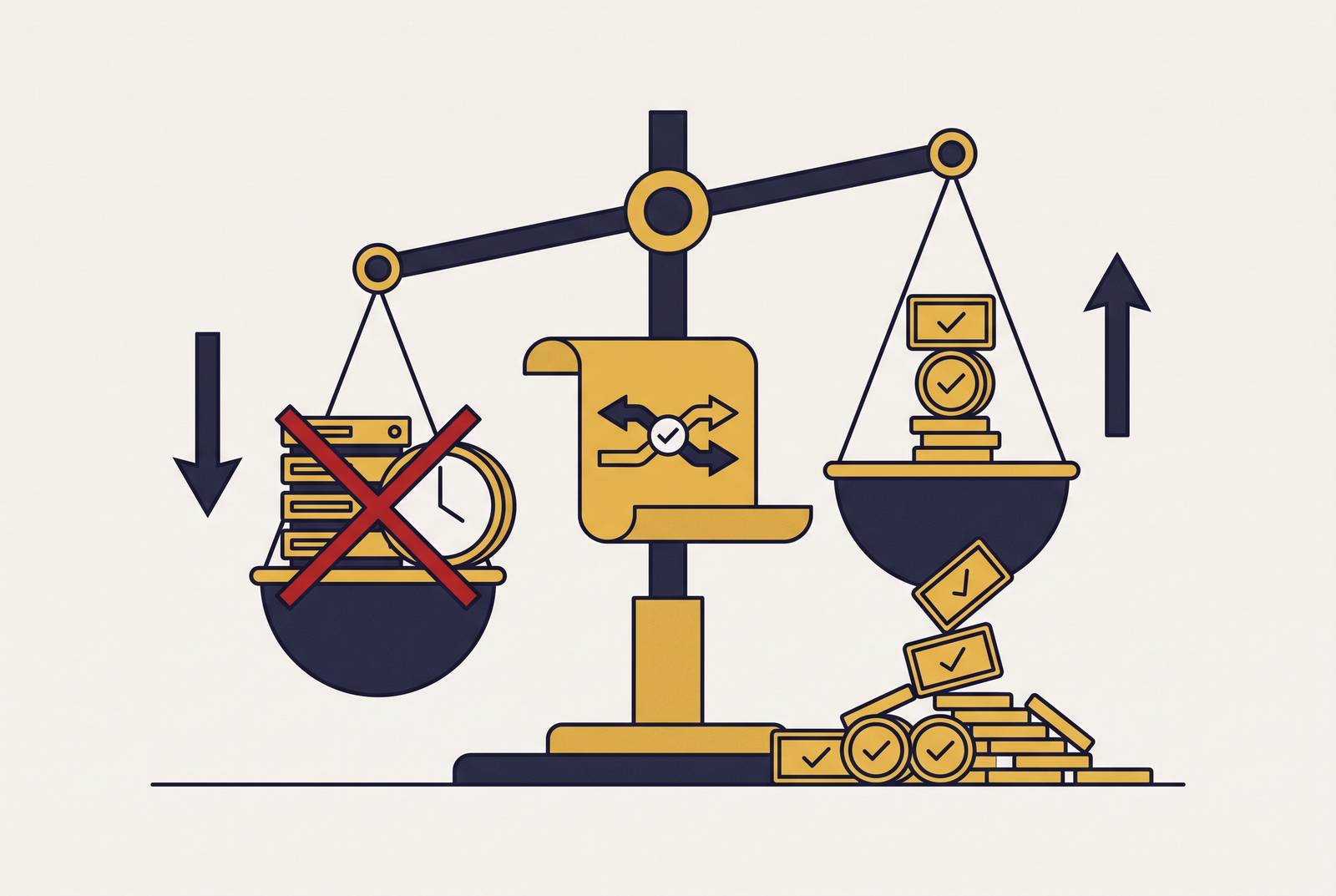
Standard SLA credits exist to cap what a vendor owes, not to make a buyer whole after an outage. That design logic has to be understood before anyone can negotiate against it with any success. A credit is a rebate against the monthly bill for the affected resource during a defined measurement window, and it is sized to the contract value, not to what the outage actually cost the buyer. A published SLA analysis covering GPU cloud contracts makes the point directly: the credit is not a payout sized to what the outage cost you. That distinction is the single most important thing to understand before treating a published SLA percentage as a form of risk protection.
Most vendor templates carry "sole and exclusive remedy" language, which closes off any claim beyond the credit amount. The credit is a ceiling on what a buyer can recover, not a floor. And because credits are almost always issued as account credit against future invoices rather than cash, a buyer who terminates the contract after a major outage may never collect even the credit they were owed in the first place, since there's no future bill left to apply it against.
None of this is accidental. SLA templates originate from the vendor's own legal team, drafted to manage the vendor's financial exposure across its entire customer base, not to compensate any single buyer for a specific loss. A buyer who accepts the standard template without negotiation is signing a document built, clause by clause, to protect the other side of the table. Every lever discussed in this piece, from measurement definitions to liability carve-outs, starts from that premise.
How uptime percentage definitions obscure the risk buyers are taking on
The headline uptime number on a vendor's pricing page is close to meaningless until three things are pinned down: what layer it measures, how an incident gets counted, and which windows are excluded from the calculation. Vendors have every incentive to define all three in their own favor, and most do.
A provider can quote different uptime figures for the same physical cluster, because it all depends on whether the guarantee covers one node, a rack of nodes, or a region-wide average. A GPU cloud SLA analysis documents this pattern directly, noting that buyers typically see only the higher number until they read the actual SLA document line by line. The gap matters most on rack-scale hardware. On systems like NVIDIA's GB200 NVL72, dozens of GPUs share a single NVLink domain, so one failed component can take down more than one customer's workload at once. A node-only SLA would still report that rack as "up," because the guarantee was never written to see the failure that actually happened.
The exclusions compound the problem. Scheduled maintenance windows, force majeure clauses broad enough to capture a DDoS event, and time spent "investigating" an incident before it's formally declared downtime all shrink the reported downtime number without the service running any better. And because severity often goes uncounted, a six-minute node failure and a six-hour rack failure can both get logged as "one incident" under the same SLA language, generating the exact same credit entitlement. Even a high-looking uptime guarantee still permits a non-trivial amount of downtime each month, and whether that time is measured at the node, the rack, or the region decides whether a buyer ever sees a credit. The number on the vendor's pricing page and the number that actually governs the contract are, in practice, two different things, and only one of them is enforceable.
Negotiating the measurement definition first
Winning the measurement definition is the first fight, and it's the one that decides how every later clause in the contract actually behaves. A buyer who defines the layer, the incident-counting method, and the exclusion scope before agreeing to any credit ladder is negotiating from solid ground. A buyer who accepts the headline percentage and moves on is accepting whatever definition serves the vendor.
Start by naming the measurement layer explicitly in the contract text. For infrastructure deals, that means committing the vendor to rack- or job-level availability, the layer the buyer's workload actually depends on, rather than a region-wide average that can stay healthy while a buyer's specific cluster is down.
Express permitted downtime in hours and minutes per month rather than as a bare percentage. The conversion forces both sides to confront, in plain terms, what the number actually permits operationally, instead of hiding behind three decimal places.
Define "incident" so severity is reflected in the credit owed. A six-hour outage should never be counted the same as a six-minute one. Tiered incident definitions, with separate credit entitlements attached to each tier, are a standard ask and a reasonable one.
Cap the exclusion windows. Scheduled maintenance, force majeure, and customer-caused outages are legitimate carve-outs on their own terms, but each one should carry a defined maximum number of hours per period. Open-ended exclusions, with no ceiling on how much time a vendor can claim back out of the calculation, quietly nullify the uptime commitment no matter what percentage sits at the top of the page.
For AI and GPU workloads specifically, push for availability measured as effective goodput or cluster-level job completion rate rather than simple endpoint reachability. The GPU cloud SLA analysis flags this as a priority negotiation point, because a node-uptime percentage would never surface the failure mode that actually dominates at scale: a node that responds to a ping while the job running on it has already failed. If you get the measurement definition right, the credit ladder and termination rights that follow actually mean something. Get it wrong, and nothing downstream of it matters.
Automatic Credit Triggers and Vendor Incentives
The size of a credit matters less than how it gets claimed. If a credit structure requires the buyer to file a claim within a short window after an incident, with supporting documentation, it hands the vendor a quiet financial incentive to let service degrade without saying so. Automatic triggers remove that incentive by taking the claim process out of the buyer's hands.
Under the standard model, a buyer has a narrow window, often a matter of days, to submit a claim backed by evidence that the outage happened and that it fell inside the SLA's definition of downtime. A team without a dedicated process for doing this will routinely leave money on the table. The GPU cloud SLA analysis is blunt about the consequence: if a team doesn't have a process for filing an SLA claim within a day of an outage, the percentage on the vendor's pricing page is closer to theoretical than real.
Automatic credit application changes the incentive structure at its root. When the vendor's own monitoring triggers the credit without a buyer-initiated claim, the procedural burden shifts to the party that caused the failure. If that shift doesn't happen, a vendor whose credits are small and claimable-only has no real financial reason to care about borderline SLA misses, and buyers who never get around to filing claims end up quietly subsidizing chronic underperformance month after month. The ask here is specific: automatic credit application based on the monitoring tool both parties already agreed to, credits applied to the next invoice by default, and no claim deadline at all when the vendor's own systems recorded the incident. Alongside that, you need to negotiate the credit cap per measurement period, the maximum a vendor will pay out in any single month no matter how many incidents occurred. A low cap means a catastrophic month costs the vendor no more than a merely mediocre one, which defeats the purpose of the credit ladder before it's even applied.
Escalating Credit Tiers and Termination Rights as Leverage
A flat credit percentage, applied the same way at every level of breach, gives a vendor a cost it can predict and manage. An escalating ladder, paired with termination rights tied to chronic failure, creates a consequence curve that actually discourages underperformance instead of just pricing it in.
Tiered credit structures tie the credit percentage to how far availability fell below the committed threshold, so a catastrophic outage costs the vendor meaningfully more than a marginal miss does. That alone changes the vendor's calculus around borderline incidents. The second lever, and the more powerful one, is the right to terminate the contract without an early-termination penalty after a defined number of SLA breaches across consecutive measurement periods. That clause turns the threat of leaving from something theoretical into something contractual and enforceable. Aryaka's published SLA framework discussion addresses this directly, noting that whether escalation rights function as real protection or empty language depends entirely on how clearly the trigger conditions are written into the contract.
Termination rights should trigger after two or three consecutive months of SLA breach at any tier, not only at the most severe one. Chronic mild underperformance does as much operational damage over time as a single large outage, and it should carry the same exit right rather than being treated as a lesser problem. The credible threat of termination changes how a vendor behaves before any breach even happens. If a vendor knows a buyer can walk away penalty-free after repeated failures, it has a financial reason to invest in actual reliability rather than simply managing the credit ladder. In infrastructure contracts specifically, hardware remediation functions as a parallel lever: committing the provider to a specific node-replacement time, not just a credit, is where real downtime risk gets absorbed rather than merely rebated. The spread in recovery time across providers is wide, and a contractual replacement-time commitment is where that risk actually changes hands. All of this, the tiers, the termination trigger, the replacement-time clause, depends on the credible threat of exit. That threat is about to get a statutory backstop for a defined set of buyers.
How the EU Data Act changes negotiating dynamics for buyers with EU exposure
If you have EU-connected workloads, the EU Data Act gives you an exit right written into statute, and that right strengthens every other SLA lever described above because it makes the threat of leaving credible without a negotiated termination clause.
Under the Act, in-scope providers have to let customers start the switching process with no more than two months' notice, with termination taking effect once that process completes. That gives buyers a unilateral path to exit mid-contract, but the law still lets providers include proportionate early termination penalties, so you don't exit entirely free of cost. The financial friction around that exit is also shrinking on a fixed schedule. Switching charges that providers have historically used to make departure expensive are being phased out, and from January 12, 2027, they're prohibited. That removes one of the main tools vendors have used to make leaving economically painful regardless of how the SLA performed.
A buyer who can credibly threaten to leave, at low cost, on short notice, backed by statute rather than by a clause the vendor's lawyers can quietly resist, negotiates every other term in the SLA from a stronger position, which is the mechanism behind all of this. The vendor's alternative to reaching an agreement is losing the contract. Outside this regulatory framework, no equivalent backstop exists. SLAs there are purely contractual, both sides are free to define terms however they can agree to, and the entire burden of building a meaningful remedy falls on the negotiator at the table. U.S. buyers can't rely on a statute to do this work for them and have to build termination rights and exit economics into the contract itself, by hand, every time. Whether or not the Data Act applies to a given buyer, the underlying mechanism is the same one running through every lever in this piece: credible exit is what gives a liability cap negotiation its teeth.
Liability cap carve-outs that recover losses credits will never reach
The liability cap itself is where the largest gap between a credit and an actual loss can be closed, at least partially, for the failure modes that matter most. It's also the clause vendors resist giving ground on more than any other.
The "sole and exclusive remedy" clause sits at the center of that resistance. It forecloses any claim for actual damages and makes the credit a ceiling on recovery rather than a floor. A doctrine called failure of essential purpose holds that a remedy that fails of its essential purpose, a credit so small it provides no meaningful compensation at all, can render an exclusive-remedy clause unenforceable. That's a legal theory with real teeth in litigation, but it also functions as a negotiating argument at the table, well before any dispute gets near a courtroom.
Where a carve-out can be drafted into the cap, the framing matters. Liquidated damages, a genuine pre-estimate of the loss a specific failure would cause, hold up. A penalty clause, designed to punish rather than compensate, generally does not hold up. Carve-out language should be built around a pre-estimated actual loss tied to a clearly defined failure mode, not around a multiplier meant to punish the vendor. Realistic targets for these carve-outs include willful misconduct and gross negligence, data loss or a breach caused by the vendor's own failure, and security incidents generally: categories vendors commonly agree to carve out because courts are likely to put them outside the cap regardless of what the contract says.
Consequential damages waivers usually run in both directions in these contracts: vendors resist giving them up for themselves, and buyers benefit from the same waiver protecting them too. You don't need to eliminate that waiver outright; you just carve specific, clearly defined categories out of it. For strategic partnerships where the relationship extends beyond a single deployment, alternative remedies can sit alongside or in place of cash-equivalent credits: extended contract terms at locked pricing, dedicated engineering resources, or priority incident response. These carry value a credit ladder was never built to capture, and they're often easier to win at the table than lifting the liability cap itself. Every lever this piece has walked through, the measurement definition, the automatic trigger, the termination right, the statutory exit where it applies, exists to put a negotiator in a position to make that last ask credibly, because a liability cap negotiated in isolation, without any of the groundwork that precedes it, rarely moves.