Negotiating Data Processing Agreements With SaaS Vendors
Prioritize which DPA clauses are actually worth fighting for.

Two in-house lawyers can negotiate a DPA with the same SaaS vendor and reach opposite outcomes within the same week, because one of them walked in with a hierarchy of what to fight for and the other did not, and DPA negotiations fail when lawyers treat every clause as equally winnable, burning negotiating capital on language that tracks GDPR Article 28 mandatory minima and cannot be moved regardless of how hard anyone pushes. A vendor's opening line that its DPA is "standard, no redlines accepted" is a negotiating posture, not a legal fact, and it works precisely because most buyers show up without a prepared list of what actually matters, so they either fold in the first round or drag the deal out for months arguing about clauses the vendor was never going to move.
The scale of the problem compounds the tactical error. A company with 200 employees typically has somewhere between 80 and 140 active DPAs across its vendor relationships, and without a standardized set of positions, every one of those negotiations starts from scratch, with counsel reconstructing redlines from memory of whatever the last deal happened to look like. That is not a sustainable way to run a legal function, and it is not how the vendors on the other side of the table operate. A late-2024 Bitkom study found that most medium-sized companies run at least five SaaS applications, and a significant share of those companies have not put legally compliant DPAs in place across all of them. That gap has started to draw direct regulatory attention. Regulators began systematic DPA compliance audits targeting cloud and SaaS services in the first quarter of 2025, and penalty proceedings opened in just the first four months of that year already outpaced the full count for all of 2023.
Some counsel respond to this pressure by arguing that the only safe posture is to fight every clause, on the theory that conceding anything invites more concessions later. That instinct is understandable but wrong. Negotiating capital is finite, and a vendor that sees a large number of redlines on a template it will not substantially alter tends to reject the whole packet or slow-walk the deal indefinitely, rather than work through it clause by clause. A prioritized approach, one that identifies in advance which terms are legally fixed, which are vendor-fixed by size and posture, and which are genuinely open, is what lets a negotiation close instead of stall.
The regulatory baseline that defines what is and is not negotiable
The legal floor underneath the DPA makes some terms non-negotiable for both sides at once, and that floor needs to be clear before any clause can be sorted into "fight for it" or "sign as written". GDPR Article 28 sets the baseline for any vendor processing personal data tied to an EU or UK data subject, and it is the strictest of the major frameworks on most of the points that matter in practice. CCPA and CPRA, along with newer state laws such as the Texas Data Privacy and Security Act, add their own processor obligations, but GDPR Article 28 requirements are stricter on most points, so a vendor that has built the GDPR framework has usually already satisfied the substance of the CCPA requirements too. That means the CCPA addendum a vendor attaches is, in most cases, definitional cleanup rather than a separate negotiation.
The AI layer has changed what counts as baseline compliance rather than remaining a bolt-on concern. The EU AI Act becomes largely applicable from August 2, 2026, with obligations for high-risk AI systems phasing in through 2027 and 2028, and it now sits alongside GDPR rather than apart from it. A DPA covering a vendor that touches AI functionality, directly or through a subprocessor, now has to address where training data came from and how algorithmic decisions can be explained, alongside the traditional processor duties around storage, access, and deletion.
Some SaaS providers try to incorporate their own external policies, trust pages, or procedures by reference rather than spelling terms out inside the DPA itself, a tactic that recurs across vendor templates. That move shifts governing language outside the four corners of the signed document and lets the vendor change it unilaterally later, without renegotiation. Knowing which provisions are legally mandatory is what allows a buyer to refuse this tactic specifically on those provisions, while still allowing it on genuinely operational, low-stakes material.
GDPR enforcement has produced substantial fines across thousands of documented actions, with processor failures under Article 28 among the recurring categories driving them. The remedy that gets less attention than the fines, an order requiring a company to stop processing data altogether, is often more damaging to a business than any monetary penalty, since it can halt a product or a customer relationship outright.
Vendor size determines which clauses will actually move
Before opening a single redline, the most consequential judgment a negotiator makes is an honest read of the vendor's size and posture, because the clause that a mid-sized SaaS company will happily discuss is often fixed and immovable at a company the size of Salesforce or Microsoft. Enterprise providers such as Salesforce, Microsoft, and Google run standard DPA templates with very limited room for customer-specific negotiation, and the better use of time with those vendors is confirming that their standard document actually satisfies the jurisdictions a given business operates in, rather than spending weeks trying to move language those companies apply uniformly across thousands of customers.
Mid-sized SaaS vendors fall at the other end of the spectrum. They tend to show the highest willingness to negotiate and will often accept real customization on a case-by-case basis, which makes this tier the one where a full, detailed set of fallback positions across all eight high-leverage clauses actually pays off. Small or niche vendors present a different kind of risk. Their templates frequently have real gaps, missing subprocessor lists, no defined deletion timeline, thin breach language, and while the theoretical leverage to add terms is often highest with a small vendor eager to close the deal, the scrutiny needed on the first read of their paper is usually greater too.
Fighting over whose document becomes the governing agreement is worth it more often with mid-sized vendors than with enterprise ones. Sophisticated buyers increasingly push their own DPA form rather than accept a vendor's template outright, and that fight is winnable more often with a mid-sized provider than with an enterprise one, so reading the tier correctly before the negotiation starts tells a buyer whether that particular battle is worth having.
One more judgment belongs before the first redline goes out, and it is easy to get wrong: confirming which party is actually the controller and which is the processor. Resale arrangements and embedded analytics tools can flip that role in ways that are not obvious from the product's marketing description. Data mapping before negotiation, understanding what categories of data move through the vendor, how they are used, and what the actual risk looks like, is what makes this judgment possible rather than guesswork. Five questions belong on paper before that first redline goes out: what tier of data is involved (business contact information versus customer personal data versus regulated categories like health records, financial data, biometric data, or children's data); who is the controller and who is the processor; which jurisdictions require coverage; and how sensitive the subprocessor chain is, including LLM providers, offshore support teams, and hyperscaler regions.
Subprocessor notice: the clause most likely to create undisclosed breach exposure
A subprocessor notice clause that gives a customer no right to object to a new subprocessor functions as a standing, unilateral permission grant. It functions as a standing, unilateral permission grant, and the enforcement record shows precisely what that gap produces in practice. The Irish DPC's landmark nine-figure fine against TikTok, imposed for unlawful transfers of EEA user data to China, illustrates the most common pattern in cross-border transfer enforcement: a gap between documented and actual data flows. The same mismatch occurs at the subprocessor level. If a DPA names five subprocessors but the vendor is actually routing data through fifteen, the vendor is in breach every time customer data touches an undisclosed subprocessor, and enterprise customers audit subprocessor lists to catch this.
AI subprocessors raise a version of this problem that a generic subprocessor clause does not solve. The market is already moving on this specific point: OpenAI's update in April 2025 shifted to a 30-day notice period paired with an objection right, and Microsoft signaled a separate 30-day notice track built specifically for AI subprocessors, both of which point toward where negotiated terms are heading industry-wide.
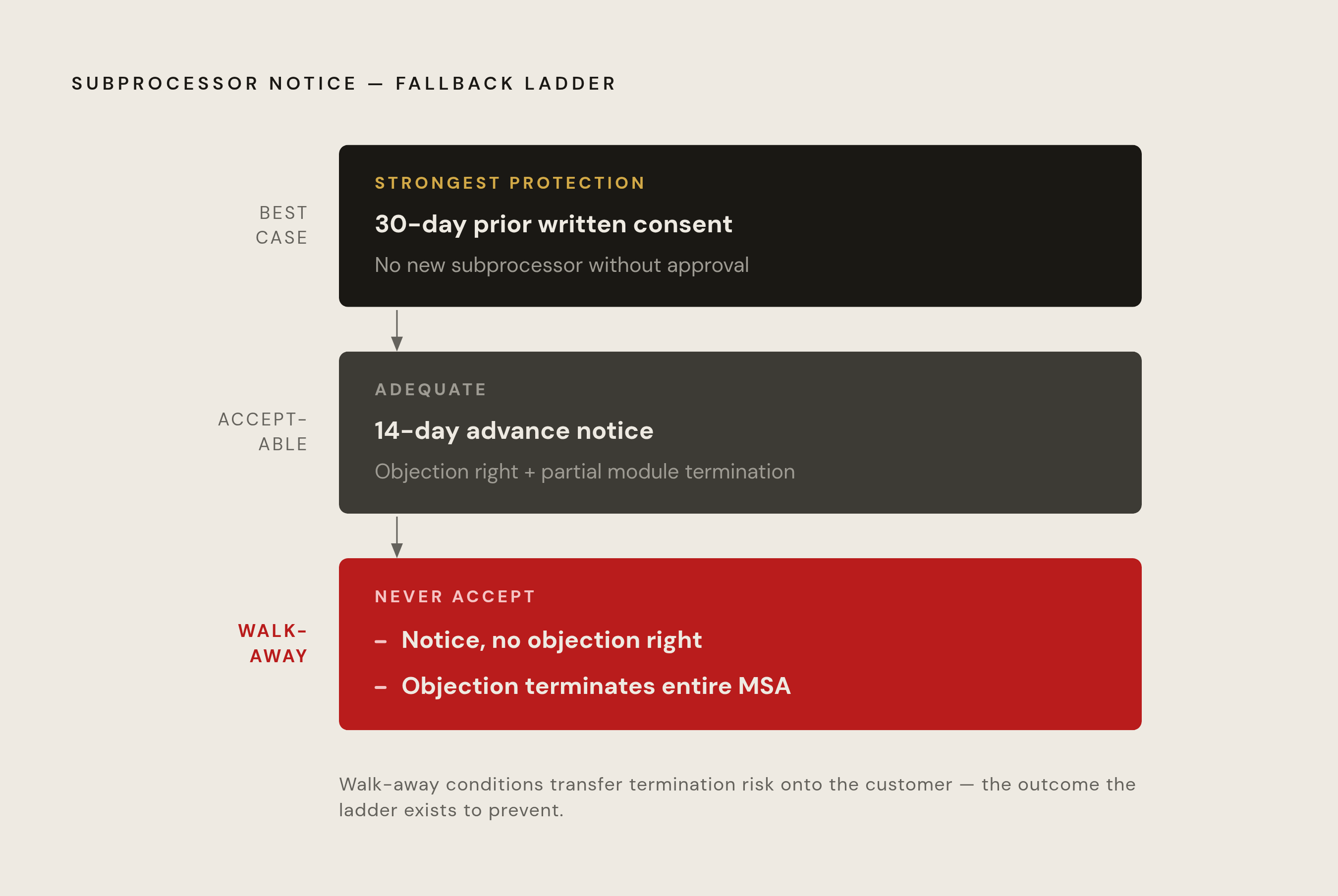
A three-level fallback structure keeps this negotiation from spiraling into an all-or-nothing fight:
- Best case: 30-day prior written consent before any new subprocessor is added.
- Acceptable: 14-day advance notice with a documented objection right and partial termination of the affected service module if the objection is not resolved.
- Walk-away: notice with no objection right at all, or a structure where an objection triggers termination of the entire master service agreement rather than just the affected piece. Both of these leave the customer operationally exposed and should not be accepted.
Vendors that proactively maintain and regularly update a public subprocessor list, describing what each subprocessor does, what data it touches, and where it is located, tend to face fewer objections during negotiation, because that transparency answers the questions a customer's legal team would otherwise have to extract clause by clause.
Audit rights: converting a compliance obligation into a workable mechanism
Audit rights are legally required by most privacy laws but operationally impossible to exercise as written in most customer-drafted DPAs, and the gap between the clause and reality is where negotiations typically stall longest. The structural problem sits on both sides of the table. Customers routinely ask for unlimited on-site audits on short notice, while SaaS vendors serving thousands of customers simultaneously cannot accommodate that volume of physical inspection without disrupting their own operations, so neither party's opening position reflects what will actually happen after signature.
The market has largely settled on a workable compromise. SOC 2 Type II report auto-delivery satisfies the GDPR Article 28 audit obligation for routine cycles, with direct on-site audit rights surviving as a fallback triggered by cause, a confirmed breach, a regulatory finding, or a material compliance concern. A tiered structure reflects this reality: start with questionnaires and a review of existing certifications like ISO or SOC reports, and reserve more invasive, on-site audits for situations where a triggering event has actually occurred or where nothing less invasive would answer the question.
A three-level fallback applies here as well:
- Best case: an annual on-site audit right with reasonable advance notice, with the vendor covering reasonable cooperation costs.
- Acceptable: SOC 2 Type II report delivered automatically on an annual cycle, plus written-question rights, plus on-site audit on cause with defined notice and reasonable cost allocation.
- Walk-away: SOC 2 available only on request rather than automatic delivery, no written-question rights, and no on-cause escalation path.
Confirm that the SOC 2 report actually covers the specific product and infrastructure handling the customer's data, not a different part of the vendor's business. A report scoped to an unrelated product line provides no real assurance about the systems that matter, no matter how clean the report itself looks.
Breach notification timelines: the word that decides whether the clause has teeth
A breach notification clause rarely fails because the number of hours or days is wrong. It fails because of a single word, whether the trigger is "aware," "confirmed," "discovered," or "reported," and that word decides whether the clock starts the moment someone inside the vendor first notices a problem or only after an internal investigation has run its course. "Aware" starts the clock at the first internal signal that something may have gone wrong. "Confirmed" can let a vendor delay formal notification for weeks while it investigates internally, and that difference between the two words has significant practical and legal consequences.
There is a real tension in how tight this timeline should be. A deadline set too short can backfire, because it leaves the vendor with too little time to gather the information both parties need to satisfy their own separate legal obligations, and a clause like that risks producing an incomplete, rushed notification rather than a useful one. The right timeline is short enough to force real speed and long enough that the notification actually contains something actionable.
GDPR requires notification to supervisory authorities within a fixed window of becoming aware of a breach, and the DPA notification to the controller must land with enough lead time to allow the controller to meet that obligation.
The fallback ladder here follows the same three-tier logic:
- Best case: notification within hours of the vendor becoming aware of any potential personal data breach, with a fuller written report following shortly after.
- Acceptable, and a reasonable landing point: notification within two days of becoming aware, with confirmed details and remediation steps following within a short period after that.
- Walk-away: notification only once the breach has been fully confirmed or internally investigated, or any timeline structured in a way that makes the controller's 72-hour GDPR obligation impossible to meet in practice.
A notification clause also needs to specify what the notice itself must contain, the category of data affected, an approximate count of the data subjects involved, the likely consequences of the breach, and the measures the vendor has already taken or plans to take. A clause that only sets a deadline without requiring this content gives the customer a timestamp and nothing else useful to act on.
Cross-border transfer mechanisms: why SCCs remain the operational backbone regardless of framework politics
Cross-border data transfers generate more GDPR enforcement activity than any other single category, which makes the transfer mechanism clause one that should never be left to default vendor language.
That caution is not abstract. The EU-US Data Privacy Framework, in effect since July 10, 2023, survived its first challenge at the General Court in September 2025, when the court dismissed the Latombe annulment case and upheld the framework. But that outcome has not settled the matter permanently. A further challenge to the framework, one observers have described as a potential "Schrems III" case following the pattern of the two prior challenges that struck down earlier EU-US transfer arrangements, has been signaled as forthcoming rather than resolved.
That history is precisely why SCCs function as the operational backbone of transfer compliance rather than a fallback used only when a broader framework is unavailable. The enforcement record on cross-border transfers is the largest single driver of GDPR fines, and the only reliable position is to negotiate SCCs into every DPA regardless of the vendor's preferred framework reliance. Building SCCs into the DPA regardless of which adequacy mechanism a vendor currently invokes is a structural safeguard. It is the version of this clause built to survive the next legal challenge, not just the current one.
Sources
- SaaS Contracts: Trends Reshaping Negotiations in 2025 and Beyond
- Data Processing Agreement (DPA) for SaaS Tools: The Complete Practical Checklist 2026
- Data Processing Agreement Negotiation Playbook for In-House Counsel
- Negotiating Data Processing Agreements: Customer and Vendor Perspectives - OGC
- OpenAI Data Privacy: 9 Enterprise Contract Clauses
- Microsoft's DPA update cuts AI subprocessor notice to 30 days
- TDPSA Data Processing Agreements
- GDPR Enforcement in 2026: When Vendor Oversight Failures Become the Fine Multiplier