Fallback Positions and Redline Strategy in SaaS Vendor Contracts
Buyers can reduce SaaS overspend by pre-negotiating clause positions before vendor talks.
Nearly every company running SaaS tools by 2025 means nearly every legal or procurement team is sitting on a pile of vendor contracts, most of them signed with barely a glance because the monthly invoice looked too small to justify a lawyer's hourly rate. That's the setup for this piece: how buyers build a pre-negotiated hierarchy of positions, clause by clause, so they're not improvising against a vendor's sales team that negotiates the same six terms a thousand times a year. The math backs up the urgency. Most CEOs and a large majority of CFOs think their own companies leave money on the table in contract talks, and Spendflo research pegs SaaS overspend from weak negotiation habits at 20 to 30 percent a year. None of that is really about legal sophistication. It's about whether anyone showed up with a plan.
What a negotiation playbook actually contains and why most teams don't have one
A contract playbook is a clause-by-clause reference document that spells out acceptable positions before anyone sits down at the table: approved language, fallback options, the risk thresholds nobody's allowed to cross without sign-off, and rules for when to kick a decision upstairs. Done well, it covers somewhere between 15 and 25 clauses, which sounds like a lot until you realize most SaaS contracts recycle the same handful of fights over and over.
The point of the exercise is delegation. A junior contract manager shouldn't need to loop in general counsel every time a vendor pushes back on a liability cap, if the playbook already says what the fallback is and when it applies.
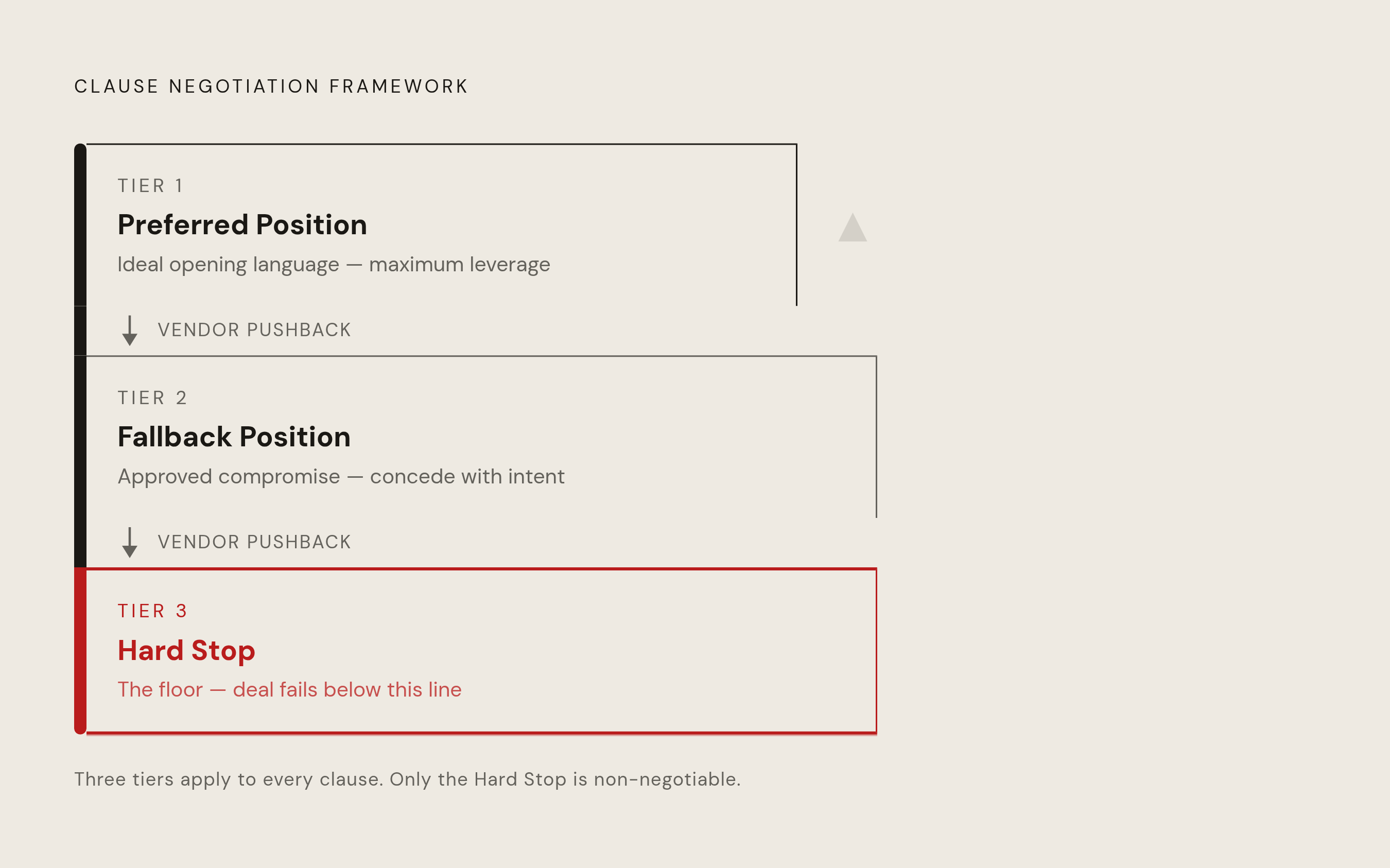
Lynden Renwick, Managing Partner at Out-House Attorneys, put it simply on a Contract Nerds webinar: what a team actually needs is "your preferred position, your fallback position and some guidance for the business." Three tiers, repeated across every clause that matters.
Preferred position: the ideal starting language, the one you'd want if you had all the leverage. Fallback position: an approved compromise, used when sales needs room to close or a strategic vendor won't budge on one specific point. Hard stop: the floor. Below this line, the deal doesn't happen, and ideally it's tied to something defensible, like a regulatory requirement, not just a gut feeling from whoever's in the room that day.
Here's the awkward part. According to the 2025 State of Contracting Survey, 95% of legal departments admit their playbooks have gaps, and 54% say they don't have one at all. So the tool everyone agrees is the right answer is one that over half of teams simply haven't built. Without it, every negotiation gets reinvented from scratch, dependent on whoever happens to remember what was conceded last time, invisible to the sales and procurement people who actually need to know where the lines are. Sirion AI recommends reviewing playbooks quarterly, or whenever the business or the regulatory landscape shifts enough to matter. Quarterly sounds frequent until you consider how fast AI clauses alone have changed in the last two years (more on that later).
The six clauses that carry almost all the risk in a SaaS agreement
A typical SaaS agreement can stretch to 50 clauses, but according to GC AI, six of them carry nearly all the actual risk: limitation of liability, indemnification, data processing and privacy, AI training and output rights, SLA and termination, and auto-renewal with pricing. Get those six locked down and the rest of the contract turns into paperwork. Assignment clauses, notice provisions, boilerplate recitals: none of that needs a fight once the six load-bearing walls are settled.
GC AI's broader checklist adds nine areas worth a second look: auto-renewal and notice windows, the liability cap, indemnification, data ownership and security exhibits, SLA uptime and service credits, termination and transition assistance, caps on price escalation, IP and feedback licenses, and assignment or change-of-control provisions. Some of these overlap with the six; the rest are the fine print that turns into a headache eighteen months into the contract, usually right when nobody has time for it.
One habit worth adopting from in-house counsel at Axiom Law: treat every URL embedded in a SaaS contract as a hidden redline. Vendors love linking out to "current privacy policy" or "acceptable use terms" that live on a webpage they can edit any time they want, without telling you. Print the linked page, attach it as an exhibit, mark it up like it's part of the contract, because functionally, it is. And insist on a precedence clause stating the signed agreement controls over whatever's sitting on that URL. AI training consent in particular tends to hide exactly there, buried three clicks deep in a privacy policy nobody read at signing.
Each of the six clauses below gets its own three-position ladder. That's really the spine of this whole piece: not a list of things to worry about, but a working method for deciding, in advance, how far to bend on each one.
Limitation of liability: the most negotiated clause in the world and how to set your three positions
Limitation of liability has held the number one spot on WorldCC's list of most negotiated terms for more than a decade, ahead of price, ahead of indemnification, ahead of everything else two lawyers might argue about. There's a reason it never gets resolved once and stays resolved: the standard cap almost never covers the actual exposure.
Consider the numbers. A common general liability cap in enterprise SaaS deals is 1x annual fees, meaning 12 months of what the buyer pays. On a modest-sized contract, that caps recovery at the same modest amount. IBM's 2025 Cost of a Data Breach report puts the global average cost of a breach in the millions of dollars (down, worth noting, from an even higher figure in 2024). Do the arithmetic and that standard cap covers roughly 2% of what a breach could actually cost. The vendor's downside is capped at a number that barely registers next to the buyer's.
The market spreads out along a spectrum. Vendor-favorable paper caps liability at three to six months of fees and excludes consequential, indirect, and incidental damages almost entirely. What passes for market standard sits at 12 months of fees with mutual exclusion of consequential damages. Mid-market software deals, per the Jonathan Lea Network, often land between one and two times annual fees.
So what should a buyer actually ask for? A three-tier ladder works here just like it does everywhere else in the playbook. The preferred position: an elevated general liability cap above the standard 12-month baseline, with a consequential-damages carve-out that's genuinely mutual, not one-sided dressed up in mutual language. The fallback: 12 months for general liability, plus a super-cap specifically for data security and confidentiality breaches, typically running 2x to 5x annual fees. ContractKen's research suggests roughly 20 to 30% of enterprise contracts already include this kind of elevated cap for exactly this reason: general liability and data breach liability are not the same risk, and treating them the same undercharges the vendor for the scarier one. The hard stop: nothing below 12 months on general liability, and no data-breach cap set so low that the vendor is effectively indifferent to whether its security actually holds up.
Common Paper's 2026 SaaS Contract Benchmark Report tracks something interesting here: 2x supercaps showed up in 2.7% of agreements signed in 2026, versus 1.7% for 5x supercaps. In 2025, the order flipped: 5x captured 2.5% of deals, 2x only 0.3%. Read that as the market drifting toward moderate multiples rather than the extreme ones, which tracks with how negotiations tend to settle once enough deals have been done to establish what's normal.
One more wrinkle that trips up more buyers than it should: how the cap is calculated matters as much as the multiple itself. "Fees paid in the 12 months preceding the claim" produces a wildly different number than "total fees paid under the agreement" on a three-year deal, which produces yet another number than "annual contract value." Nail down the definition, or the multiple you negotiated so carefully turns out to mean something else entirely.
And don't forget to ask whether indemnification sits inside or outside this cap. It's one of the most fought-over sub-issues in enterprise contracts, and it has to be spelled out explicitly. Leave it implied and you'll find out the hard way which side's lawyer wrote the ambiguity.
Indemnification: separating the non-negotiable floor from the clauses where concession is reasonable
Not every indemnity clause deserves the same fight. Some are worth dying on a hill for. Others are worth trading away just to get the meeting moving.
Start with IP infringement indemnity, because this one shouldn't even be a negotiation. If the vendor's software turns out to infringe someone else's patent, that's the vendor's problem to fix and the vendor's cost to bear. Demanding this uncapped is industry standard, not a stretch position, and any vendor resisting it is worth a second look.
Data breach indemnity is where things get genuinely contentious, because vendors resist it hard, and yet it's arguably the clause that matters most given how much personal data flows through SaaS platforms. The preferred position: full indemnity when the breach traces back to the vendor's own security failure. If the vendor won't go there, the fallback is narrower but still meaningful: coverage for specific direct costs like regulatory fines, customer notification expenses, and credit monitoring services. The hard stop is simple. No indemnity at all for a vendor-caused breach isn't acceptable once personal data is anywhere in the contract's scope.
Mutual indemnity clauses deserve a closer read than they usually get, because "mutual" often hides an imbalance. It's reasonable for the buyer to indemnify the vendor if the buyer's own data infringes someone's rights, sure. It's not reasonable for the buyer to indemnify the vendor against claims arising from the buyer's ordinary use of the service. That second version quietly hands the vendor's product risk back to the customer, dressed up as fairness.
Bari Williams, Head of Legal and Legal Content at LegalOn Technologies, summed up the philosophy on damages caps with a phrase worth remembering: "You want to have damages capped. Cap. Cap. Cap. I'm going to say yes all day, please." Caps aren't just a vendor's shield. They're the buyer's leash on exposure too, and worth fighting for on both sides of the table.
One more thing worth watching for, courtesy of Renwick again: exclusive remedy language tucked into the indemnification section. "I'm very wary of anything that says this will be your exclusive remedy," he said, and it's a fair warning. An indemnity that quietly becomes the only remedy available closes off every other avenue, including termination or direct damages claims, the moment something goes wrong.
Data processing agreements: the fallback ladder when a vendor resists your DPA
DPAs look like paperwork until the day a subprocessor gets breached and nobody agreed in advance on who has to tell whom, or when. The negotiable territory here includes what counts as a sub-processor in the first place, who has to approve a new one, what audit rights actually look like on paper versus in practice, how fast breach notice has to happen, and what happens to the data the day the contract ends.
For any vendor with EU exposure, the SCC module question, controller-to-processor versus processor-to-processor, needs to get identified early, because it changes the entire structure of the compliance obligations downstream. For regulated data, the DPA has to carry the right annex: a HIPAA business associate agreement, GLBA terms, or a FERPA exhibit, depending on the sector. These aren't fallback material. They're walk-away conditions, full stop.
Vaquill AI's SaaS Agreement Playbook lays out a fallback ladder that's worth adapting directly. Preferred: the buyer's own DPA, on the buyer's own terms. First fallback: the vendor's DPA, but with negotiated breach-notice timing and real subprocessor controls written in. Second fallback: contractual security commitments plus a right to request the vendor's current audit report on demand. Hard stop: no DPA at all when personal data is in scope, breach notice left entirely to the vendor's discretion, or security commitments that amount to nothing more than a marketing page dressed up as a legal document.
Gartner research puts the value lost to missed contractual obligations at 8.4% across contracts generally, and DPA provisions are among the obligations most likely to go unmonitored once the ink dries. Nobody's checking the DPA six months after signing. That's exactly when it matters most.
AI training and output rights: the newest redline category and why it requires an explicit clause
This clause was rarely seen in standard SaaS templates until recently, which says something about how fast the ground has shifted under procurement teams who thought they'd already seen every trick in the boilerplate.
The risk hides in old language that used to sound harmless. Provisions letting a vendor "improve," "build," or "enhance" its product, phrasing that's been standard in SaaS contracts for years, can now stretch to cover AI training and fine-tuning on customer data, according to reporting from PYMNTS. Nobody wrote that language with model training in mind, but it's broad enough to cover it anyway.
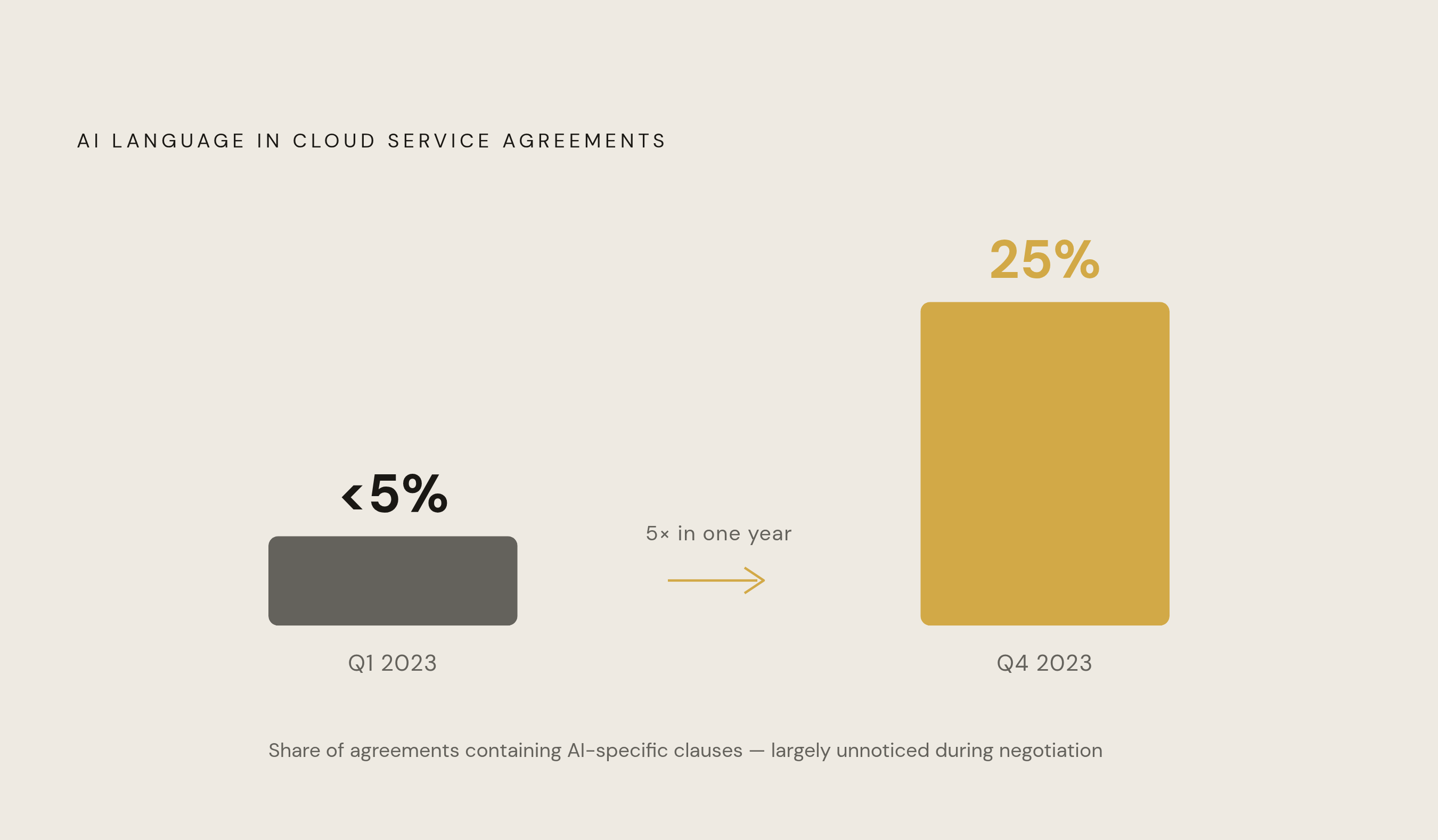
The adoption numbers tell the story of how fast this moved. Language mentioning AI showed up in less than 5% of Cloud Service Agreements in the first quarter of 2023. By the fourth quarter of that same year, it was in 25%. That's not a gradual drift. That's a clause going from nonexistent to majority-standard in under two years.
So what belongs in the playbook now? An explicit prohibition on using customer data to train, fine-tune, or otherwise improve AI models without separate written consent, not blanket consent buried in a "we may improve our services" clause from three sections earlier. Clear ownership of AI-generated outputs, especially when those outputs incorporate customer data or customer-specific configuration. And a sunset clause: if the vendor adds AI features after the contract's already signed, the customer's opt-out right survives without needing to renegotiate the whole agreement.
Axiom Law's URL warning applies here with extra force, maybe more than anywhere else in the contract. AI consent language loves to hide in a linked privacy policy rather than the signed document itself, which is exactly why the precedence clause matters: whatever's signed controls, whatever's linked doesn't get to quietly expand later.
If the vendor won't agree to an outright prohibition, there's still a workable fallback: negotiate an opt-out of AI training, get written confirmation that any outputs trained on the buyer's data aren't shared with other customers, and secure a data deletion right that reaches into the training sets themselves, not just the live production data.
Auto-renewal and term clauses: where buyers lose the most money without realizing it
Vendors like evergreen contracts. Auto-renewal fires automatically unless the buyer sends written notice inside a specific window, and that window is often 60 to 90 days before the renewal date, timed just awkwardly enough that busy procurement teams miss it more often than anyone wants to admit.
Renwick doesn't mince words on this one: "My preferred position is no automatic renewal…I would not be surprised to find that there is more than a billion dollars globally of what I will call unintentional business." Unintentional business. That's a polite way of describing money that changed hands because somebody forgot to check a calendar.
The ladder here is straightforward. Preferred: no automatic renewal at all, the contract simply ends at term unless someone actively renews it. Fallback: automatic renewal is fine, but only if the vendor has to send notice before the renewal window even opens, and only with a cap on how much the price can jump at renewal. Hard stop: automatic renewal with zero advance notice and no ceiling on price increases isn't something any buyer should sign, no matter how good the software is.
Price-escalation caps deserve their own line item. More SaaS contracts now build in year-over-year increases as a matter of course, and if that increase isn't tied to something concrete (a named index, a fixed percentage ceiling), the vendor gets to decide the number unilaterally at renewal time, with the buyer finding out only when the invoice lands.
Termination rights matter just as much. Vendors typically fight termination for convenience, and fair enough, that's their revenue on the line. But buyers should push for it anyway, or at minimum secure a defined transition period with real data portability obligations attached, so walking away doesn't mean losing access to years of the buyer's own data on the way out the door.
Payment terms round out the fight. Vendors generally want annual fees paid upfront in full. Buyers should push back with prorated refunds on early termination and resist penalty clauses on disputed amounts. Renwick again, on the subject of late fees tied to disputes: "I'm only going to pay a modest amount of penalties for undisputed fees that I've missed…because it creates an incentive for you to not meaningfully engage in the dispute conversation." Which is really the whole point of a penalty clause done wrong: it punishes the customer for disputing a charge instead of encouraging the vendor to resolve the dispute.
How to sequence redlines so you preserve leverage without stalling the deal
Sending every redline back at once, all six clauses marked up simultaneously, reads as adversarial before either side has said a word out loud. It burns goodwill before the actual conversation even starts, and vendors notice. Sales teams talk to each other. A buyer known for scorched-earth first drafts gets slower responses and less flexibility on the clauses that matter.
A better approach sequences the asks in two rounds. Round one carries only the hard-stop positions, the clauses where the fallback already is the floor and there's no more room to give. Send those first. They filter out vendors who can't meet the baseline requirements before anyone wastes time negotiating the details, and they frame the entire rest of the conversation around what's actually non-negotiable rather than what merely sounds aggressive.
Round two brings the fallback positions in as trades. Give ground somewhere low-stakes, maybe a notice period, maybe a minor SLA detail, in exchange for real movement on liability or data protection. That's the mechanism that keeps the deal moving instead of stalling: concede visibly on the clauses that don't carry much risk, and spend that goodwill on the six that do.
None of this requires guessing in the room. It requires having already decided, clause by clause, what the preferred position is, what the fallback looks like, and where the floor sits, long before the vendor's paper ever lands in the inbox. The 95% of legal teams with playbook gaps, and the 54% with no playbook at all, are the ones negotiating each of these six clauses from scratch every single time, which is a strange way to run a portfolio of contracts that all share the exact same risks.
Sources
- 11 actionable vendor negotiation strategies (+best practices)
- Dioptra ai
- How to Build and Use a SaaS Agreement Playbook: The Great 8
- A SaaS Agreement Has up to 50 Clauses. Six Carry the Risk. — GC AI
- SaaS Agreement Playbook: Clause-by-Clause Positions for Reviewing Vendor Paper
- legalontech.com
- gc.ai
- axiomlaw.com