Redlining Speed Benchmarks for In-House Legal Teams
Most contract review delays live outside the legal team, not within it.

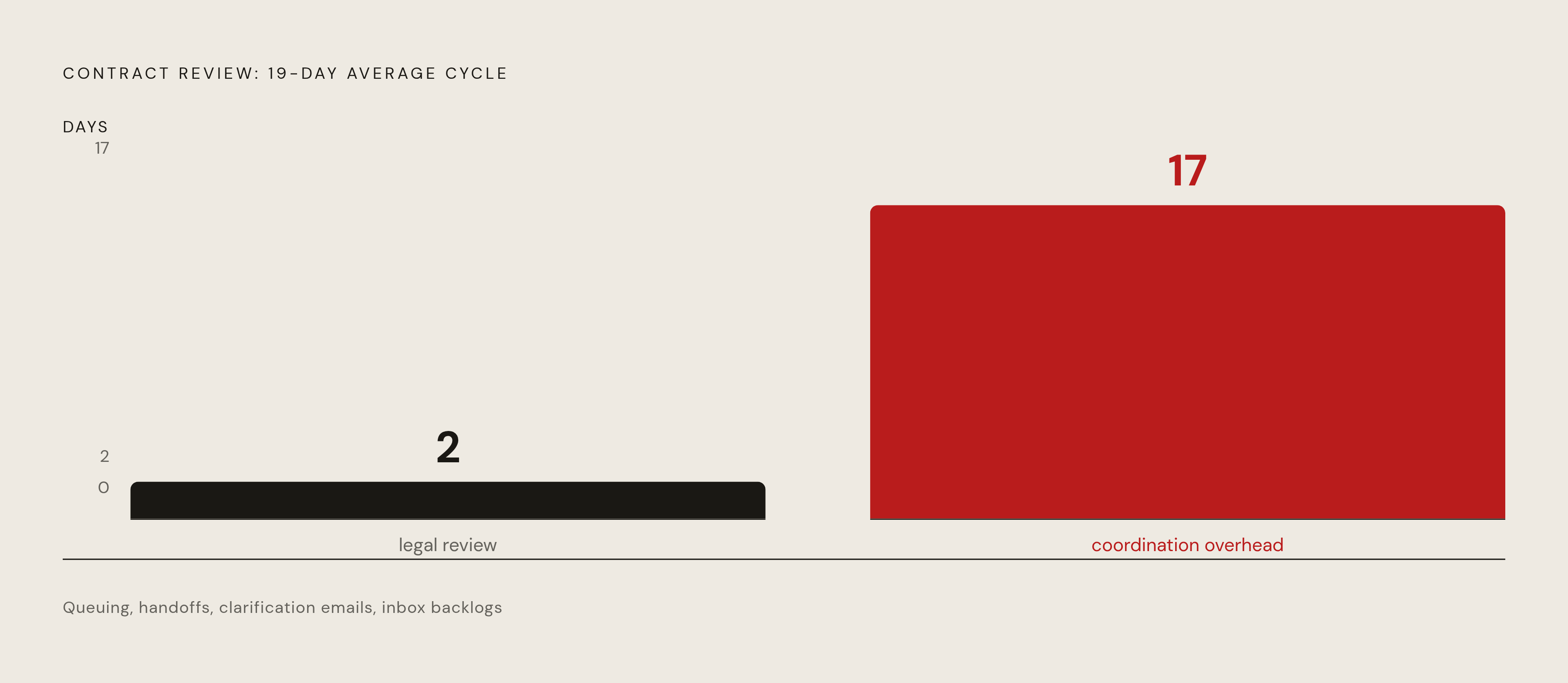
Nineteen days: that's the average contract review cycle from submission to signature, per Elasticflow data. On its own, that number sounds bad enough. What should actually bother a legal ops leader is what's sitting inside those 19 days.
About 2 of them are spent on legal work. The other 17 are queuing, waiting on a handoff, sending a clarification email and waiting for someone to answer it, or sitting in an inbox behind three higher priorities. Once you sit with that split, the number stops meaning what it used to. A team reporting a 19-day turnaround is very likely reporting a coordination problem, not a lawyer-speed problem, but that only becomes visible once the 2 days and the 17 days get pulled apart instead of blended into one average that flatters no one and indicts no one either.
Here's a separate number worth holding on its own: in-house counsel spends around 3.2 hours per contract on actual review. That's countable, and it behaves nothing like the 19-day figure. Run it for a mid-market team pushing 500 contracts a year and review labor alone adds up to roughly 1,600 hours, or 200 full working days, before anyone even counts the 17 days of overhead stacked on top.
Splitting hours of labor from elapsed calendar days is the first move any legal ops leader should make before touching a tool, a vendor, or a headcount request. The rest of this piece builds off that split, so it's worth getting comfortable with now.
Contract-type benchmarks that high-performing teams actually hit
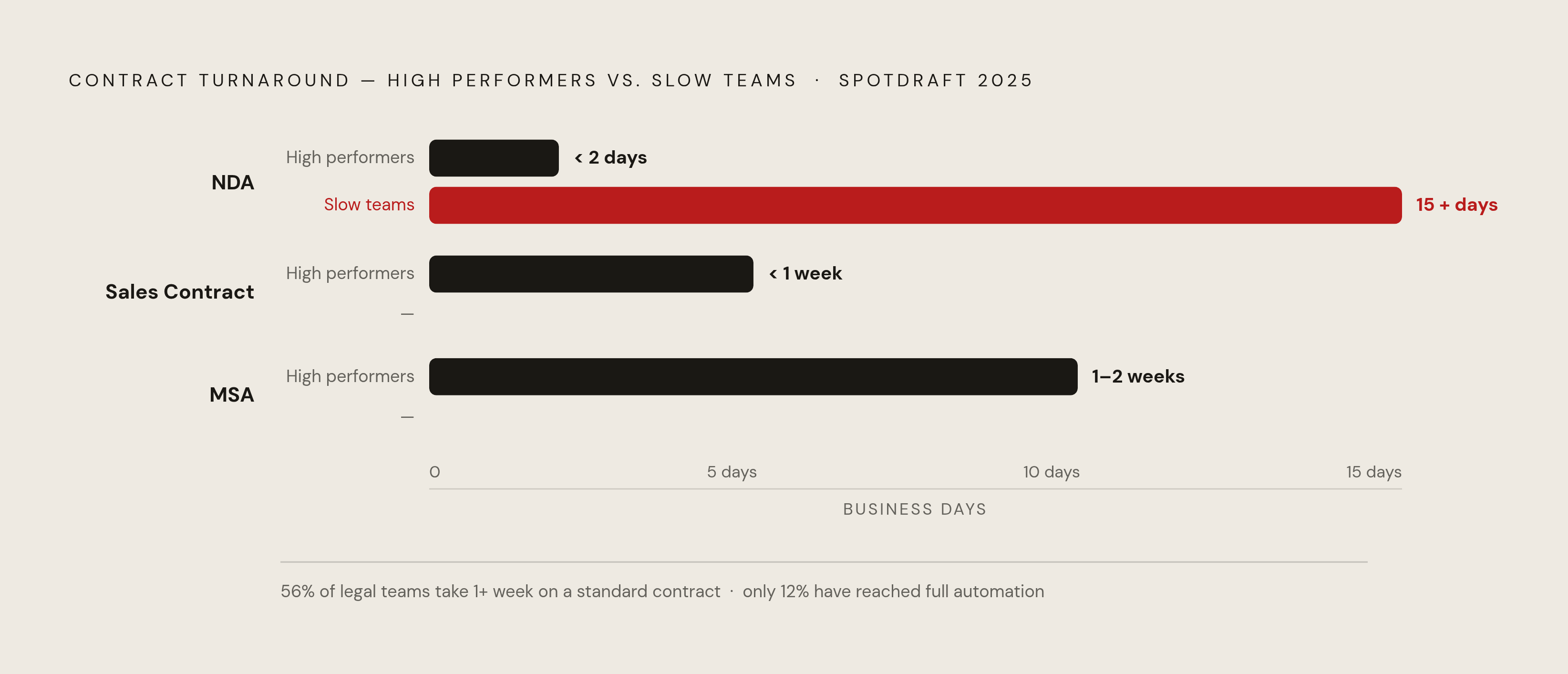
Averages flatten a spread that matters more than the average itself. Per SpotDraft's 2025 numbers, high performers close NDAs in under two business days, while slower teams can stretch to 15-plus days for the same document. Sales contracts follow the same shape, under a week for high performers. MSAs, which carry more negotiated complexity, run one to two weeks for high-performing teams, for what is, structurally, a template with a few negotiated schedules bolted on.
SpotDraft's 2025 Contract Efficiency Benchmarking Survey pulled from 115 in-house departments, none of them SpotDraft customers, and found 56% of legal teams take a week or more to close a standard contract. Some reported 15-plus days for an NDA, a document type that barely changes shape from one counterparty to the next. Only 12% of teams surveyed have reached full automation of their contract process. That's the tell: the benchmark gap is the median condition here, not some rare outlier problem confined to a handful of laggards.
Sector data adds a wrinkle worth sitting with. Fintech and IT legal teams lead with 3-to-4-day turnaround cycles, and those same sectors posted substantial year-over-year growth. That correlation doesn't prove speed causes growth; a dozen other variables could be doing that work instead. Still, it does suggest contracting velocity behaves as a leading indicator rather than a back-office efficiency stat nobody outside legal cares about.
What actually separates fast teams from slow ones isn't the software sitting on someone's desktop. It's pre-approved fallback positions written down somewhere accessible, playbook-driven first-pass review that doesn't require partner-level sign-off for routine language, and escalation logic that's documented rather than living exclusively in one senior counsel's head.
The pressure environment that makes these benchmarks urgent rather than aspirational
None of this happens in a vacuum where teams get to hit benchmark parity whenever it's convenient. The Thomson Reuters Institute's 2024 Legal Department Operations Index, surveying 80 U.S. legal ops professionals, found 79% of departments seeing rising matter volume while 67% report flat or shrinking attorney headcount. Put those two numbers side by side and you get a gap between demand and capacity that's getting wider, not narrower.
Budgets aren't the escape hatch either. Fifty-eight percent of departments report flat to declining total budgets, which rules out the easy fix of just hiring more lawyers. SpotDraft's 2025 State of Legal Ops survey found 54% of in-house legal teams run with just 1 to 5 members, and 44% of organizations have no dedicated legal ops function at all. The teams absorbing the most volume pressure are frequently the ones with the least structural capacity to absorb it, which reflects a design flaw baked into how legal departments scale, rather than bad luck.
What does sitting still actually cost? World Commerce & Contracting data puts average revenue loss from contracting inefficiency at 9.2% of annual revenue. Separately, 57% of business development professionals say contracting delays hit revenue recognition directly, meaning a slow contract eventually shows up as a line item in finance's quarterly variance report, not just as an annoyance in legal's inbox.
Outside counsel is the pressure valve most departments reach for when internal capacity runs out, and it costs real money. ACC's 2024 benchmarking puts median outside counsel spend at $1.8 million per department, with outside counsel absorbing about 87% of the total external legal budget. Every dollar routed there because an internal team couldn't keep pace is a dollar a faster internal process could have kept in-house instead.
How to tell whether slowness is a legal problem or a process problem
Here's the diagnostic question that actually matters: when does the clock stop moving, and who's holding it at that moment?
Time piling up before the contract reaches legal is an intake and routing problem. Time piling up while legal has the document is a capacity or complexity problem, the kind a playbook or an extra reviewer might genuinely fix. Time piling up after legal sends back redlines is a negotiation and counterparty problem, and no internal tool touches that one, no matter how it's marketed on the sales call.
gc.ai's metrics analysis draws exactly this line: if first-redline time is two days but the contract then sits untouched for three weeks afterward, the bottleneck lives entirely outside the legal team's control. That finding alone should change which fix gets funded next quarter.
Three metrics deserve to be tracked separately, and "days to close" as a single blended number should probably get retired as the primary KPI most departments still lean on. Time to first redline measures how responsive the legal team is. Legal hold time measures internal review and approval bandwidth. Negotiation cycle measures counterparty friction, which sits mostly outside legal's control and reflects the other side's incentives as much as anything happening internally.
The tooling baseline underneath all this is rougher than most vendor pitches let on. A January 2024 poll found 92% of contracts professionals still exchange redlines through Microsoft Word Track Changes, and 49% of legal teams manage contracts through some mix of email, Word documents, and shared folders. Reconciling three versions of a Word doc because someone attached the wrong file to an email thread is a process cost, plain and simple, and no amount of legal talent fixes a version-control problem.
Contract cycle time remains the most tracked metric in legal ops; 39% of respondents in SpotDraft's 2025 State of Legal Ops survey name faster turnaround a top priority, and only a small fraction describe their process as anywhere near fully optimized. That gap between what gets tracked and what actually gets fixed is itself a diagnostic finding, maybe the most useful one in this piece.
The practical output here is unglamorous but it works: map where time actually goes across the three phases, before legal, with legal, after legal, before buying anything or reorganizing anyone's job.
What automation does and does not compress in the redlining cycle
AI compresses one specific phase, and it compresses it hard: first-pass markup, going from hours down to minutes. Aggregated 2024-25 benchmark data from Sirion shows cycle-time cuts of 45 to 90% when automated, playbook-driven redlining replaces manual first-pass review. That's a real number.
It's solving a real time-allocation problem too. Under manual review, legal teams spend somewhere between 60 and 80% of their time on routine contract review, the kind of markup that's closer to pattern-matching against known clauses than to judgment calls requiring a law degree. Shift that proportion and lawyers get real hours back for the work that actually needs one.
Available data suggests the review pass compresses dramatically when AI tools are introduced, while the negotiation layer, where a human decides which redline to fight for and which to give up, barely moves at all.
That's a structural limit, not a flaw in the tools themselves. Negotiation decisions, which changes to accept, which to push back on, which to trade for a better term elsewhere in the contract, require judgment about risk appetite, counterparty relationship, and deal context that no model infers on its own. Risk thresholds differ by organization, and they shift by deal size and by who's sitting across the table. AI needs those thresholds programmed explicitly into a playbook; it doesn't pick them up the way a lawyer who's negotiated with the same vendor for three years does.
Cameron Clark, Head of Legal at Arc'teryx, put it plainly in a case study for GC AI: "What used to take an hour, like reviewing contract feedback and drafting a reply, now takes ten minutes, and the results are better." Notice what that quote claims and what it doesn't claim. It's a first-pass compression finding, not a negotiation-replacement finding.
So here's the practical read for anyone shopping a redlining tool: if negotiation is where the clock actually stops in a given department, and it often is the longest phase by far, expecting an 80% total cycle-time cut from a new AI tool sets up disappointment. The tool fixed a real problem. It just wasn't necessarily the department's biggest one.
The playbook infrastructure that separates real speed gains from demo-room promises
Here's the part most teams skip, and it's the part that actually decides whether an AI redlining rollout works or just sits there generating disappointing usage stats. Analysis of high-performing deployments consistently shows that the most successful AI redlining implementations depend on meticulously built playbooks that encode institutional knowledge and specific risk thresholds. Skip that groundwork and the tool has nothing to redline against except generic defaults, which means it will flag the same boilerplate everyone already ignores.
Building that playbook is not an afternoon project. It usually means combing through a substantial set of recently negotiated contracts to pull out consistent lawyer preferences, documented fallback positions, and clear escalation thresholds. It's a one-time cost, but a real one, and it's the unglamorous labor that happens before anyone gets to claim a speed win in a board deck.
The payoff shows up in SpotDraft's 2025 benchmarking: organizations at automation level 3 close contracts an average of 8 days faster than those stuck at level 1. That gap is a playbook maturity gap far more than it's a difference in whose logo sits on the software.
Worth saying plainly: most organizations see meaningful accuracy gains during the tuning period that follows deployment, not on day one. The first pass out of the box is rarely the best pass a tool will ever produce, so teams should plan for a calibration phase instead of expecting demo-room performance the moment the contract's signed.
That changes how a tool should get judged. A platform built for deep playbook customization, one where institutional knowledge gets encoded explicitly, is a categorically different product from a generic drafting assistant, even when both wear the same "AI redlining" label. And for the 54% of teams running with 1 to 5 people, playbook-building competes directly with the live contract work already stacked on someone's desk. How the rollout gets sequenced matters as much as which vendor gets picked.
How to evaluate AI redlining tools against these benchmarks
Four questions map directly onto the diagnostic framework above, and they're worth asking in this order during any vendor call, not as a checklist to rush through.
First: redline compression. How fast does the tool produce a marked-up draft against a specific, loaded playbook, not against a generic template pulled from a demo account? Second: playbook customization depth. Can institutional fallback positions and risk thresholds get encoded explicitly, or does the tool offer a fixed menu of presets and call it customization? Third: workflow integration. Does it actually kill the email-and-shared-folder overhead that 49% of teams are still stuck in, or does it just become a fifth tool bolted onto an already scattered stack? Fourth: accuracy calibration. Does the vendor support independent benchmarking, or point only to internal studies that happen to favor their own numbers?
A few named tools show how differently this space approaches the same problem. Some platforms offer fully autonomous first-pass review for NDAs and routine agreements, reading the document against a playbook and returning redlines without a human touching the first pass. Dioptra positions its offering toward enterprise teams dealing with higher contract volume and complexity. Other tools aim to compress standard third-party review time significantly for teams handling large volumes of NDAs and vendor paper. GC AI's own customer survey, based on 100-plus active users polled in December 2025, reports an average of 14 hours saved per week per lawyer and a 14% cut in outside counsel spend; run against the ACC's $1.8 million median outside counsel figure, that 14% turns into a dollar amount most CFOs would actually notice on a report.
One question is worth pressing on every vendor, regardless of the logo on the slide deck: ask for cycle-time data segmented by contract type, NDA versus MSA versus enterprise agreement, instead of one blended average. A blended speed claim hides exactly the contract-type variation that decides whether a tool fits a department's actual mix of work.
Reading your own numbers against the benchmarks
Start with the last 50 contracts a department closed, segmented by contract type. Not a blended average; a blended average is exactly the number that caused this diagnostic confusion in the first place.
Map each type against the benchmarks above. NDAs closing beyond two business days point to either a routing problem before legal ever sees the document, or a genuine capacity problem once it lands there, and the 2-day-versus-17-day split from earlier in this piece is what tells a team which one it's actually facing. MSAs running past two weeks get the same treatment: is it legal hold time, or negotiation cycle, before anyone pins the delay on the legal team. And for any contract type where the wait after redlines go out is longer than the wait before legal ever touched the file, the bottleneck sits with the counterparty, or with whoever inside the business signs off next, not with legal.
If legal hold time turns out to be the real constraint, and the team is burning 60 to 80% of its review hours on routine markup instead of substantive judgment calls, that's the signal that playbook-driven AI solves the right problem. Should the 17 days of overhead instead dominate the cycle while legal's own work time is already low, buying a faster redlining tool just adds speed to a phase that was never the bottleneck. That team needs intake, routing, and approval workflow fixes first, not another AI subscription line item.
One more data point worth sitting with: an ACC and Everlaw genAI survey found a strong majority of in-house professionals expect generative AI to cut their reliance on outside counsel. That expectation only becomes real once the tool gets pointed at the actual constraint, not just the most visible one.
Teams hitting benchmark-level numbers across NDAs, MSAs, and sales contracts tend to share one habit more than any particular software pick: they know exactly where their clock stops, and every tool or workflow change they've made was built around that specific point, not around a general hope that things would get faster eventually.