Redline Review Prioritization for Lean Legal Teams
Systematic clause triage cuts contract review time without sacrificing risk coverage.
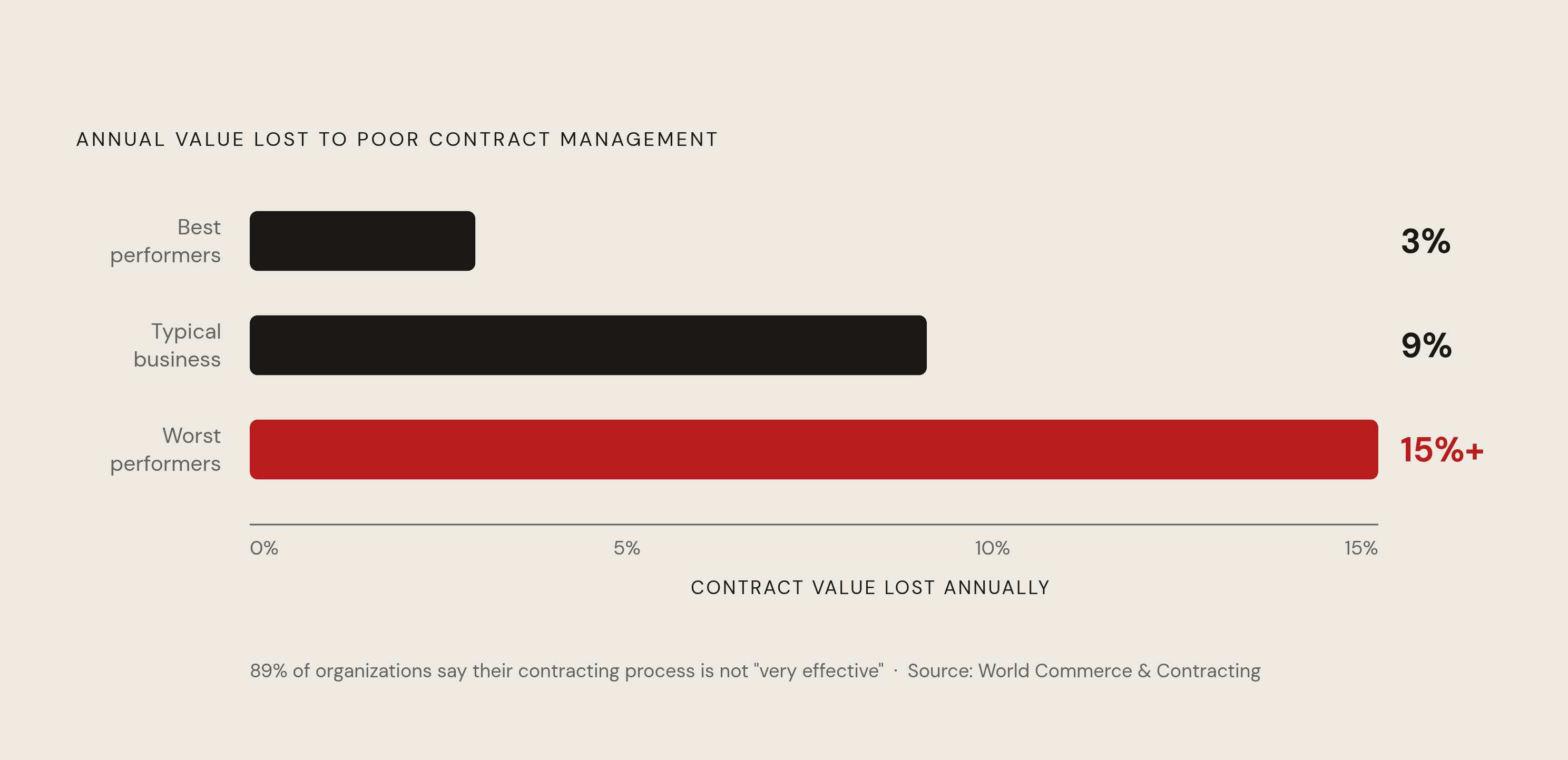
Poor contract management costs the average business almost 9% of value annually, according to World Commerce and Contracting's August 2025 research. The best performers lose roughly 3%; the worst lose 15% or more. That spread is the whole argument in one line: the gap between top and bottom has nothing to do with who has smarter lawyers and everything to do with who processes deals better. Most legal departments would rather blame headcount than admit they have a workflow problem, and that instinct is backwards. Understaffing is real, but it doesn't explain why a routine vendor renewal gets the same three-hour read as a merger agreement.
Here's where the framing usually goes wrong: people assume the cost sits in contracts everyone already knows are dangerous. But legal teams spend 60% to 80% of their time on contract review, and a large share of that time goes toward reviewing low-risk agreements with the same care as high-exposure ones. Reviewing a single low-complexity agreement can run as much as $6,900 in internal time. Spend that kind of money on a routine renewal, and the diligence has quietly become a margin problem.
The most telling number in the set: 89% of organizations say their contracting process isn't "very effective." That's the whole industry, not a handful of overwhelmed teams. So where does the actual failure hide? Rarely in the contract everyone flagged as risky going in and read five times. It hides in the contract nobody flagged at all, because nobody scored it in the first place. The danger sits in the paper that got waved through more often than in the paper that got the careful read; that's the part most legal teams get exactly backwards, and it's the whole reason triage has to start before anyone opens a document.
The five clause categories where almost all exposure lives
Triage has to start at the clause level, not the contract level. Reading a document top to bottom hunting for the two paragraphs that matter wastes time better spent elsewhere. The smarter move goes straight to the provisions most likely to cause a future dispute and skips the rest until there's time to spare, which there usually isn't.
Practitioners keep converging on the same five categories: limitation of liability (plus its carve-outs), indemnification, termination and auto-renewal, IP ownership, and data privacy. Get through only those five before the queue forces a move to the next file, and the important work is done. Everything past that is lower priority, and most legal teams can't afford to treat it otherwise.
Limitation of liability sets the ceiling on what a company can recover or owe, but the ceiling matters less than its exceptions. Carve-outs for gross negligence, IP infringement, or data breach are where that ceiling quietly disappears; a lawyer who skips the carve-outs has read half the clause and missed the half that matters. Indemnification determines who eats the legal costs if a third party sues, and asymmetric drafting here can leave one party holding the other's entire defense bill. Termination and auto-renewal cover exit rights, notice windows, and lock-in periods, and missed auto-renewal deadlines remain a recurring, entirely preventable source of contracts nobody meant to keep. IP ownership decides who owns work product and the improvements built on top of it, which matters enormously in vendor and SaaS paper. Data privacy covers processing obligations, breach notification timelines, and subprocessor restrictions, terms that grow less negotiable and more jurisdiction-specific every year.
None of this works without contract-level triage sitting on top of it, though. Spending two hours combing a low-value tool contract for indemnification language is its own kind of misallocation. Two minutes on that contract and two hours on the data-heavy MSA sitting next to it is the correct split. Reviewing the five categories first doesn't mean reviewing them at the same depth every time; it means knowing, fast, whether a contract needs the deep read at all.
How to score contracts before reading them
Contract risk scoring decides, before a lawyer opens the document, roughly how much exposure sits inside it. The score comes from clause content, deviations from the team's playbook, the counterparty's profile, and how similar past agreements actually played out. In plain terms, it turns a lawyer's gut instinct into a number procurement and finance can act on too.
A practical model assigns each clause category a weight based on how much damage a deviation could do there. Limitation of liability, IP ownership, and data privacy tend to score highest, somewhere around 8 to 10 on a defined scale, because deviations there carry outsized consequences relative to almost everything else on the page. Set a threshold: contracts above it route to a senior lawyer, contracts below it move to accelerated approval or self-service. Catching the bad stuff matters, but giving the team explicit permission to stop worrying about the safe stuff matters just as much, and most teams never build that permission structure at all.
Two scoring approaches exist, and most teams get the order backwards, reaching for the fancier one first. Rule-based scoring works from day one, inside whatever the playbook already covers, and doesn't need a mountain of historical data to function. Learned scoring needs a large corpus of previously reviewed and labeled contracts before it calibrates well, adding precision gradually as that corpus builds. Starting with rules makes more sense, since a system that needs data a team doesn't have yet will stall for a quarter with nothing to show for it. The learned components get layered in once there's a real inventory of past decisions to train against, not before.
Scoring models take in more than clause text: contract value, whether the counterparty is new or a repeat partner, whether it's in a regulated industry, the deal type, and, critically, whose paper is on the table. Third-party paper needs clause-level scoring from scratch, because there's no baseline to compare against. A company's own template, even with a few negotiated tweaks, is a known-deviation review; the team already knows what the paper is supposed to say. That single distinction, own paper versus third-party paper, is the most useful sorting question in the entire triage process.
Building the playbook that powers the triage system
A playbook lays out positions rather than reciting law. For every material clause, it states the market position the team wants, the fallback offered if the counterparty pushes back, and the specific point at which the issue climbs the chain to a senior lawyer or the business.
Most AI contract review tools now operate directly against a playbook: a checklist run against the document that grades risk, extracts key terms, and drafts redline suggestions. A well-built playbook separates AI-assisted review, which actually saves time, from AI-generated noise, which just produces more text to read. That distinction gets ignored constantly, and it's central to whether the whole system works. Skip it, and the AI layer becomes a faster way to produce the wrong output.
A complete clause entry needs four parts. The acceptable range covers positions the team takes without escalation at all. The fallback is what gets offered when the counterparty's language sits outside that range. The escalation trigger is the exact deviation that forces a senior lawyer or business stakeholder into the room. And, where relevant, the walk-away condition marks the line past which the deal isn't worth doing, full stop.
The playbook's real value shows up in operations more than in law. It removes routine decisions from a lawyer's desk permanently; a reviewer who already knows the team's accepted range on liability caps doesn't reason from first principles every time one shows up. The most common failure, and it's a subtle one, is a playbook that handles easy cases well but leaves escalation triggers vague. Vague triggers push reviewers to escalate everything out of caution, which defeats the purpose entirely. A playbook that generates constant escalation ends up functioning like no playbook at all, just with extra paperwork attached.
Someone has to own it too, which sounds obvious and gets skipped anyway. Who updates positions, how often they get reviewed, what forces a revision: new regulation, a pattern of lost deals tied to one clause, a shift in how much risk the business can carry. As of August 2025, 80% of legal departments say they plan to shift toward more strategic work, but only 12% have end-to-end contract automation in place. That gap is the playbook, more often than not; it's the missing piece between the intention and the automation. Written down clearly enough, it sets the floor for delegation: a non-lawyer can handle first-pass routing without legal ever getting pulled in.
Keeping low-risk contracts off the lawyer's desk entirely
The whole framework collapses if low-risk contracts keep landing on a lawyer's desk anyway. Triage speed matters, but volume reduction matters more, since a faster read of a contract that never needed a lawyer is still wasted time.
Self-service workflows for high-volume, low-risk paper (NDAs, routine renewals, standard order forms) can cut legal review requests by 60% to 80% and shrink contract cycle times by 75% or more. The routing logic is conditional: contracts above a set dollar threshold, or containing language flagged as non-standard, escalate automatically. Everything else completes on its own, no lawyer involved, no lawyer even aware it happened.
Here's a useful gut check for any team wondering if it's actually lean or just short-staffed: if every single NDA still needs a lawyer's eyes before it goes out, the team is doing the same work with fewer hands and calling the exhaustion "triage." That resembles attrition dressed up as process discipline, and it doesn't hold up under scrutiny. A team that's actually triaging has fewer contracts reaching a lawyer, not just faster reads of all of them.
Making self-service safe takes three concrete things. Approved templates with locked fields, so a counterparty can't quietly alter material terms while signing what looks like the standard form. Routing rules tied directly to the risk score, not to someone's judgment call on a busy Thursday. And escalation triggers written in plain language business users can actually understand, not legal jargon that gets skimmed and ignored.
Good candidates for self-service include mutual NDAs on the company's own paper, routine SaaS renewals under a set value threshold, and standard order forms operating under a master agreement already negotiated once. Clear review stages, running from triage through final approval, keep routine paper from getting stuck in the same lane as genuinely complex deals. That separation works as a structural choice, something built into the workflow rather than hoped for. The same logic scales down inside the legal team itself: documented positions and clear thresholds let junior staff handle routine deviations without pulling a senior lawyer into every conversation.
Where AI tools fit into the triage workflow and what accuracy to expect
AI adoption in contracting jumped to 42% of organizations in 2025, up from 30% the year before. The live question is how to fit it into a triage workflow that already has rules of its own, because AI without a playbook underneath it just produces faster guessing. Misapplied speed is worse than slowness, since it multiplies the wrong reads instead of just delaying the right one.
Against roughly 92 minutes for a human first pass, AI tools have completed comparable reviews in about 26 seconds. That gap is the number everyone quotes, and it's the least interesting part of the story. Speed without a documented position to check against produces fast noise, and fast noise helps no one; a wrong answer in 26 seconds is still a wrong answer.
What AI actually does well here is narrow and mechanical: identifying clauses, flagging deviations against the playbook, feeding inputs into the risk score, drafting first-pass redlines on positions the team has already documented. That's the repetitive layer of review, and confusing it with the judgment layer is where teams get into trouble.
Accuracy numbers from vendor testing land in a useful range without being a guarantee of anything. In 2025 real-world testing with Wilson Sonsini, Dioptra reported 95% accuracy on first-party contracts, 92% on third-party contracts, and 94% on issue detection. Worth noticing: accuracy drops on third-party paper across every one of those figures, which tracks with the earlier point about unfamiliar paper being harder to score. Familiar paper is easier to check because there's a known answer key sitting right next to it; third-party paper offers no such reference point, so the model guesses at a slightly higher rate.
RSGI's November 2025 study of Harvey's customer base found a typical user saving 15.7 hours per month. That figure matters more than the 26-second number, because it measures what happens after the first pass, once a lawyer still has to make every escalation call by hand.
Treating AI as a substitute for judgment is the actual risk here. AI runs the mechanical pass; a lawyer still makes the escalation call, handles genuinely novel risk configurations, and steps in on any clause the playbook has no documented position on. A playbook gap under an AI pass tends to produce more wrong answers per minute rather than saved time.
What a working triage system looks like end to end
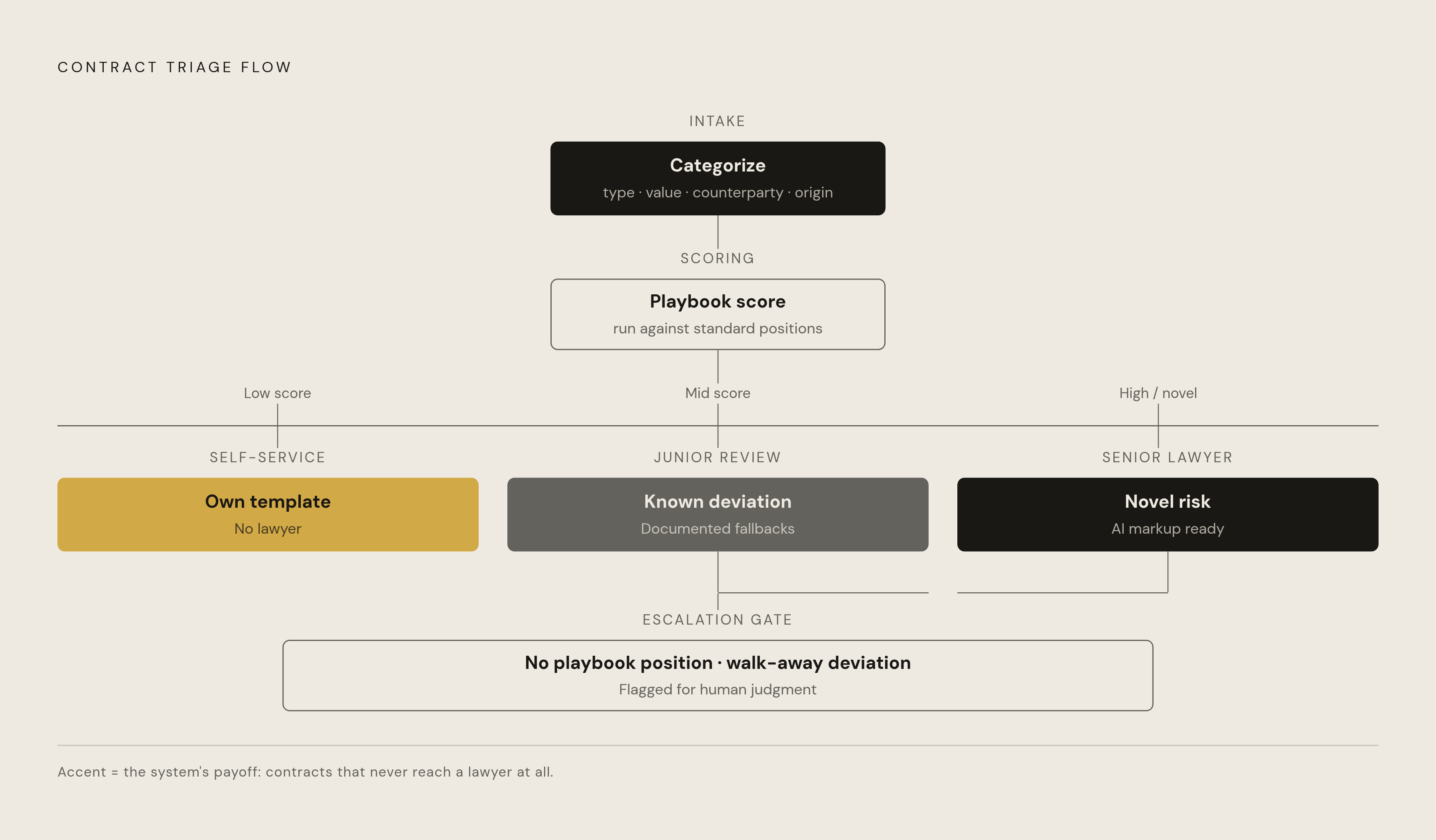
A triage system runs on sequence more than software. Decisions get made in the right order, using the right information, by the right person, or sometimes by no person at all.
Intake comes first. A contract arrives and gets categorized immediately by type, value, counterparty, and paper origin, all before a lawyer looks at a single line. Scoring comes next: the contract runs against the playbook, and the resulting score determines which lane it enters. Below a set threshold on the team's own template, it goes straight to self-service, no lawyer involved. A mid-range score with a standard, previously-seen deviation goes to a junior reviewer working against documented fallback positions. A high score, or a risk configuration nobody's seen before, goes to a senior lawyer, but by the time it lands there, AI has already run its first-pass markup.
That ordering matters more than it sounds like it should. For any contract that reaches a lawyer, AI has already flagged the deviations, scored the clause-level risk, and drafted redlines on anything with a documented position. The lawyer reviews AI output at that point, working from a marked-up draft rather than a blank page. Escalation is the final gate: any clause with no playbook position, or any deviation crossing a defined walk-away line, gets flagged explicitly for a human judgment call. Everything else resolves against guidance that already exists, without anyone reinventing the answer that afternoon for the hundredth time.
What this produces that scattered individual effort never does is consistency: the same risk threshold applied to every contract that comes through, not just the ones a particular lawyer happened to read carefully on a slow day. That consistency matters as much as raw speed, more than people tend to credit it, and it's easy to lose sight of once the AI numbers start looking impressive on their own.
None of it holds up on its own, though. The playbook needs updating when positions shift, and routing rules need recalibrating as the mix of deal types changes over time. AI accuracy needs periodic checking against real outcomes too, because a system tuned for last year's contract mix drifts quietly out of step with this year's, and nobody notices until something routed as low-risk turns out not to have been.