Termination for Convenience Rights in Vendor Agreements
Procedural missteps when invoking the clause can turn your exit into a breach claim.

A termination for convenience clause lets a party walk away from a contract, and it does not have to show the other side did anything wrong. No breach has to be alleged, and no threshold condition has to be met. The terminating party gives written notice, waits out whatever notice period the contract specifies, and then the agreement ends.
That mechanism did not originate in commercial dealmaking. It came from government procurement, where FAR 49.502 lays out the exact clause language a contracting officer must insert depending on the type of contract involved: fixed-price agreements above or below the simplified acquisition threshold, the services short form, research and development work (with separate, no-profit terms for educational and nonprofit institutions), dismantling and demolition contracts, and construction. The government's version of the clause is built on a specific rationale: agencies need to stay free to adjust to new policy priorities, reallocated budgets, and changing public needs. That logic made sense for an entity that answers to shifting appropriations, but it does not carry over on its own when two private companies sign a multi-year services agreement.
The clause migrated anyway. The clause now appears in nearly every category of commercial contract, especially in technology, outsourcing, and professional services deals that run for several years. It is worth distinguishing it from two mechanisms it often gets confused with. Termination for default, or breach, needs proof that a party failed to meet its obligations, and it can expose that party to damages and to reputational harm in future bidding. A break clause operates only at fixed intervals written into the contract, not at any time the holder chooses. Termination for convenience sits apart from both: no fault, no fixed window, just notice and a waiting period.
The clause reads as simple on its face: exit without cause, give notice, walk away. Whether the clause actually protects the party holding it depends on who holds the clause, what the notice period requires, what payments survive, and what happens to operations afterward, none of which appears in that one simple sentence.
Why scrutiny of the clause has intensified
Two forces have pushed this clause out of the boilerplate and into active legal scrutiny: a wave of mass terminations across the U.S. federal government, and new regulatory pressure building around cloud and SaaS contracts. The government case study is the richer of the two, and it offers a warning that applies well beyond federal contracting.
The clearest example came out of a sweeping review of foreign aid contracts at a major federal agency. On March 10, 2025, Secretary of State Marco Rubio announced that the review had concluded and that the vast majority of USAID programs had been cut. USAID itself was officially closed on July 1, 2025, and what remained of its programs moved to the State Department. The USDA ran a parallel exercise, terminating contracts in fiscal year 2025 and saving $64.4 million in the process, with no litigation costs and only some settlement costs recorded as of March 20, 2026. For the party doing the terminating, this is the clause working exactly as designed: a tool for cutting costs cleanly and fast.
But the federal experience also exposed the clause's limits. Legal counsel David Robbins pointed out that what the government was doing was not always a proper termination for convenience. A real T4C needs an administrative step, since a contracting officer has to issue a formal letter, but in a number of instances the government just imposed funding freezes and refused to pay. Robbins characterized some of that conduct as a blatant breach and refusal to pay rather than a lawful exercise of the convenience right. Judge Ali then issued a preliminary injunction, and it blocked enforcement of suspensions, stop-work orders, and terminations affecting foreign aid contracts issued between January 20 and February 13, 2025.
The lesson transfers directly to commercial contracting: a termination for convenience clause only protects the party invoking it if that party follows the procedural steps the clause actually requires. If you skip the formal notice, what looked like a cost-free exit can turn into an actionable breach claim. Private-sector legal teams are watching this unfold in real time, and it is reshaping how carefully they draft and enforce the procedural mechanics of their own T4C clauses. On the regulatory side, new pressure is also building in the cloud and SaaS markets around how these clauses get drafted, so vendor exit rights in technology contracts are facing tighter scrutiny.
The right holder and the asymmetry it creates
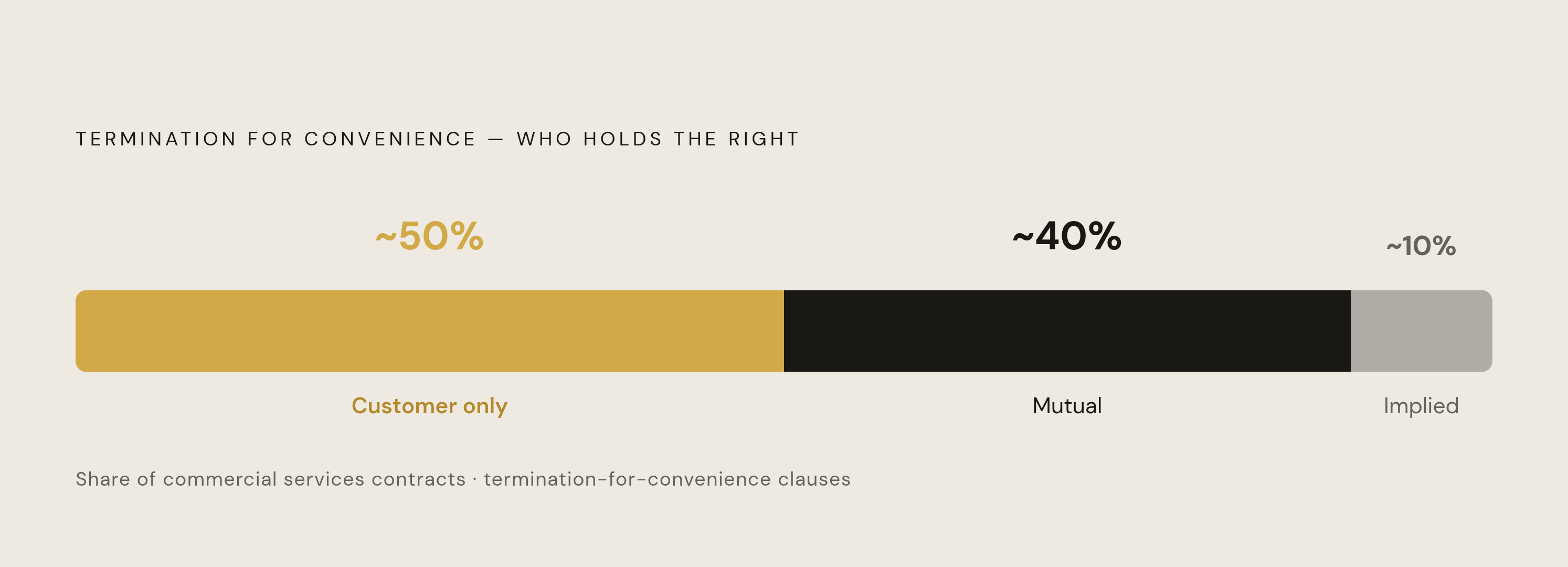
Mutual termination for convenience rights, where either party can walk away, appear in roughly two-fifths of commercial services contracts. Customer-only rights, where only the party paying for the service can terminate without cause, show up in roughly half. This split matters, because when a vendor holds a mutual right, it has leverage throughout the life of the contract that customers typically assume belongs to them alone. A customer who believes it holds the only exit ramp, and structures its planning around that assumption, may discover that the vendor can walk away on the same terms whenever it chooses, particularly in exclusive dealing arrangements where the vendor has made its own commitment to exclusivity in exchange for that right.
Notice periods compound the asymmetry. A vendor agreement that gives the vendor only a matter of days to terminate for breach, after a cure period runs out, while requiring the customer to give months of notice to terminate for convenience, builds a one-sided exit architecture into the contract from the start: fast and cheap for the vendor, slow and expensive for the customer. The most common notice period for termination for convenience in technology contracts runs 60 days, but outsourcing and managed services agreements can need much longer when the transition is complex, and it can stretch to several months. That window carries real consequences. If the notice period is too short, the non-terminating party may not have time to migrate its data, retrain staff, or line up a replacement vendor before access ends.
The sharpest version of this asymmetry appears in what might be called the hidden payment acceleration trap, which shows how a clause can look protective while functioning as the opposite, as in the following SaaS agreement. A different provision in the payment terms produces this: exercising that termination right triggers acceleration of all remaining fees through the end of the contract term, which is how the clause's protective appearance turns into its opposite. In effect, the customer is asked to pay nearly the full remaining value of the contract just to stop receiving the service. It is a right that exists in the document but cannot be exercised without incurring a cost close to the cost of simply staying.
What payments survive termination
The payment acceleration trap illustrates a broader truth: it is the payment provisions, not the existence of the exit right itself, that determine what termination actually costs and whether the clause has any real economic value. Both sides of these negotiations routinely underestimate how complicated this gets once notice is actually given.
For the non-terminating party, which in most commercial relationships is the vendor, the baseline entitlement is straightforward in principle: payment for work already performed and accepted through the effective termination date, along with payment for work in progress that cannot reasonably be stopped mid-stream. You should write that baseline into the contract, instead of leaving it to whatever default rule a court might apply later, because default law varies and gives neither side certainty.
Vendors with real negotiating leverage typically push for more protection than that floor gives. A termination fee, sometimes called an early termination charge, compensates for stranded setup costs and lost profit margin in contracts that required significant upfront investment, and the amount typically declines the further into the contract term the termination occurs, often structured as a function of the months remaining in a minimum term multiplied by a percentage of the monthly fee. A minimum initial term works alongside this, because it blocks the convenience right entirely for some opening period, so the vendor gets a guaranteed window to recover its setup costs before any exit is even possible. Contractken.com describes one version of this structure directly: a three-year contract might include a 12-month minimum term, after which either party may terminate for convenience on 90 days' notice. Vendors who have made commitments to third-party infrastructure providers or subcontractors in reliance on the contract also need explicit language to establish who absorbs those costs if the customer exits early, because silence on this point tends to leave the vendor holding obligations it took on only because the customer relationship was supposed to last.
Implementation fees deserve separate treatment. The work that precedes any recurring revenue, security reviews, configuration, data mapping, system integrations, training, is usually sunk cost for the vendor the moment it happens, and treating those fees as non-refundable is a reasonable way to protect that investment rather than exposing it to clawback on an early exit.
The broader principle holds regardless of which side of the table a given clause favors: the contract should state explicitly how prepaid fees and deposits are handled, whether refunds are prorated by time elapsed or by deliverables completed, and how final invoicing is timed. A clause that stays silent on these questions defers the fight to whatever moment termination actually happens, when both sides have the least incentive to cooperate.
What happens to data and operations after notice
The most dangerous window in a SaaS or technology contract is often not the termination decision itself but the notice period that follows it, and most clauses say almost nothing about what is supposed to happen during that stretch of time.
The vendor's obligation to return data raises a separate issue. If a vendor exercises its termination for convenience right and the contract has no data-return obligation, the vendor may have no legal duty at all to give the customer continued access to its own data once the notice period runs out. That leaves the customer racing the clock: whatever window the notice period provides is also the only window the customer has to extract everything it needs, and for large or structurally complex datasets, that window is frequently not long enough. Default legal rules on data portability and data return differ from one jurisdiction to another, so if a clause stays silent on this point, the customer's position depends entirely on whichever jurisdiction's default happens to apply, and no customer should want to find that out only after notice has already been given.
A well-drafted wind-down provision addresses a specific set of operational questions directly, so they do not get fought over later. It should state how long the customer retains platform access once notice is delivered. It should specify the format in which data will be returned and whether building or running the export tooling is the vendor's responsibility. It should define what transition assistance the vendor owes the customer: knowledge transfer, documentation handover, and cooperation with whatever successor vendor the customer brings in. It should address what happens to integrations that were only partially completed at the time of termination, along with AI-generated outputs and custom configurations built specifically for that customer. It should settle who owns the intellectual property in deliverables and outputs produced before the termination date. And it should state whether third-party commitments the vendor made on the customer's behalf, infrastructure contracts or subcontractor arrangements, transfer to the customer, terminate outright, or get wound down, and at whose expense.
Certain obligations need to survive termination explicitly regardless of how the rest of the wind-down is handled: confidentiality, indemnification, data security obligations, and any audit rights tied to the terminated period. These are routinely left out of survival clauses, and they become the subject of dispute precisely when the termination itself is already contentious and trust between the parties has already broken down.
Smaller vendors face a particular version of this risk. If a vendor depends heavily on one or two major contracts, it often does not have the staff to run a proper transition while it absorbs the business disruption a sudden termination causes. If the clause does not address timing and resource allocation for that transition assistance, the vendor ends up providing it at its own uncompensated cost, right when its revenue from that customer has stopped.
Whether good faith limits the right to terminate
Whether a party exercising a termination for convenience right owes any duty of good faith is one of the most contested questions in contract law, and the answer courts give depends heavily on jurisdiction, the specific language of the clause, and whether the underlying contract governs goods or services.
Some courts take a restrictive view, reading a good faith obligation into the exercise of the right even when the contract text says nothing about it. Under that approach, a termination motivated by bad faith, timed specifically to avoid paying a bonus that was about to vest, say, or used as a pretext to dodge some other contractual obligation, can be challenged even though the clause on its face permits termination without cause at any time. Other courts take the opposite position: if a contract grants an unambiguous right to terminate for convenience, that right can be exercised for any reason or no reason at all, and importing a good faith requirement would rewrite a bargain the parties struck deliberately.
That split means the practical value of a termination for convenience clause cannot be assessed from its text alone. The same clause language can work very differently depending on which jurisdiction's courts end up interpreting it, so the governing law provision in a contract carrying a T4C clause needs the same scrutiny as the termination clause itself. A party negotiating one of these agreements needs to understand not just what the clause says, but what a court sitting in the relevant jurisdiction is likely to read into the silence around it.
Sources
- 49.502 Termination for convenience of the Government.
- Addressing Termination for Convenience Clauses in Vendor Contracts - Attorney Aaron Hall
- 7 Exit Risks Companies Miss in Termination for Convenience Clauses
- Do you need to include a termination for convenience clause in your vendor agreements?
- Termination for Convenience in Contracts: Key Elements & Best Practices
- Terminating Contracts for Convenience: Legal Considerations - Attorney Aaron Hall
- The origins of termination for convenience clauses
- A Roadmap for Terminations for Convenience in the DOGE-Era - Government Contracts Navigator