Most Negotiated Clauses in Technology Vendor Contracts
Five overlooked contract clauses can cost millions when AI systems fail or infringe.
Technology vendor contracts look different line by line, but the fights they generate do not. Negotiators spend their time on liability caps, indemnification, data rights, termination, and payment terms, deal after deal, regardless of what the vendor sells. These clauses are not arbitrary battlegrounds. Each one answers a version of the same question: who pays, and how much, when the vendor's system fails, infringes someone's rights, leaks data, or leaves the buyer unable to walk away. A support contract, a storage platform, and a model provider all raise this question in slightly different clothes. The same five or six clauses keep absorbing the negotiation's energy no matter what is on the invoice.
Industry data backs this up from an odd angle: studies have found a gap between where negotiators spend their time and which terms actually drive the best outcomes for the buyer. That gap doesn't argue for spending less time on liability and indemnification. It argues for spending that time with a clearer understanding of the mechanism each clause controls, so the hours go toward the cap level and the carve-out list rather than toward wording that makes little financial difference either way. A 2026 software contract negotiation guide names SLA and liability terms among the highest-return items to address before signing, which lines up with what the clause mechanics themselves suggest: a cap or an indemnity gap changes who absorbs a loss measured in the millions, while most other contract language changes little beyond procedure.
AI vendor contracts have pushed several of these clauses past what standard SaaS templates were built to handle. The year between August 2025 and August 2026 turned what used to be theoretical risk into settled fact: a landmark copyright settlement, new state laws requiring AI developers to disclose what they trained on, and active EU AI Act enforcement all arrived inside that window. Each of the sections that follow takes up one clause in its familiar, pre-AI form, then shows what generative AI has changed about the risk that clause is supposed to control.
Limitation of liability: the clause that sets the financial ceiling for everything else
Limitation of liability deserves to be read first because it sets the outer boundary on every other protection in the contract. An indemnification clause, a data-breach obligation, a warranty: none of them matter once this clause fixes the total amount you can recover. Vendors typically ask for a cap equal to total fees paid or payable in the period before the dispute arose, and that 1x annual fees structure has become the standard starting position. That number sounds reasonable until you apply it to an AI tool priced at a few thousand dollars a year that happens to process sensitive health or financial data. If that tool fails or leaks records, the harm it causes can run into the millions, but the vendor's maximum exposure stays frozen at whatever the buyer paid that year.
Negotiating this clause well means working two levers. The first is the cap figure itself: whether it's set at one year of fees, a multiple of that figure, or a fixed dollar amount tied to the buyer's actual risk. The second, which negotiators miss more often, is the list of carve-outs excluded from the cap. Confidentiality breaches, IP indemnification obligations, data breach liability, and gross negligence or willful misconduct should all sit outside the general cap as a baseline position, not an ambitious ask. A vendor's uptime failure that costs a buyer a day of lost revenue is the kind of consequential damage that standard exclusion language is written to eliminate. The fight over "indirect, incidental, special, or consequential damages" matters as much as the cap number itself. That language typically sweeps in lost profits, lost data, and business interruption, the very categories of harm a SaaS or AI outage is most likely to cause. Buyers should push to carve data loss, regulatory penalties, and security-breach costs out of that exclusion, since these are foreseeable, direct results of the vendor failing to do its job rather than some remote, speculative category of harm.
In the AI context, the cap-and-carve-out structure carries even more weight. A promise to indemnify a buyer against a copyright claim over AI-generated output means little if that promise is subject to the same low cap that governs a routine service complaint. Many AI vendor contracts put one uniform ceiling over all claim types, IP infringement included, so a buyer's protection against a copyright suit can end up capped at a figure that covers only a small fraction of what that lawsuit would cost to defend and resolve. The fix is structural: IP indemnification and data-breach liability need to sit outside the general cap, or sit under their own separate and higher cap calibrated to what litigation in that area actually costs. Get this wrong, and the indemnification clause a buyer thinks it negotiated turns out to be worth far less than it appears on paper, a problem the next section takes up directly.
Indemnification: where the contract assigns blame for AI outputs
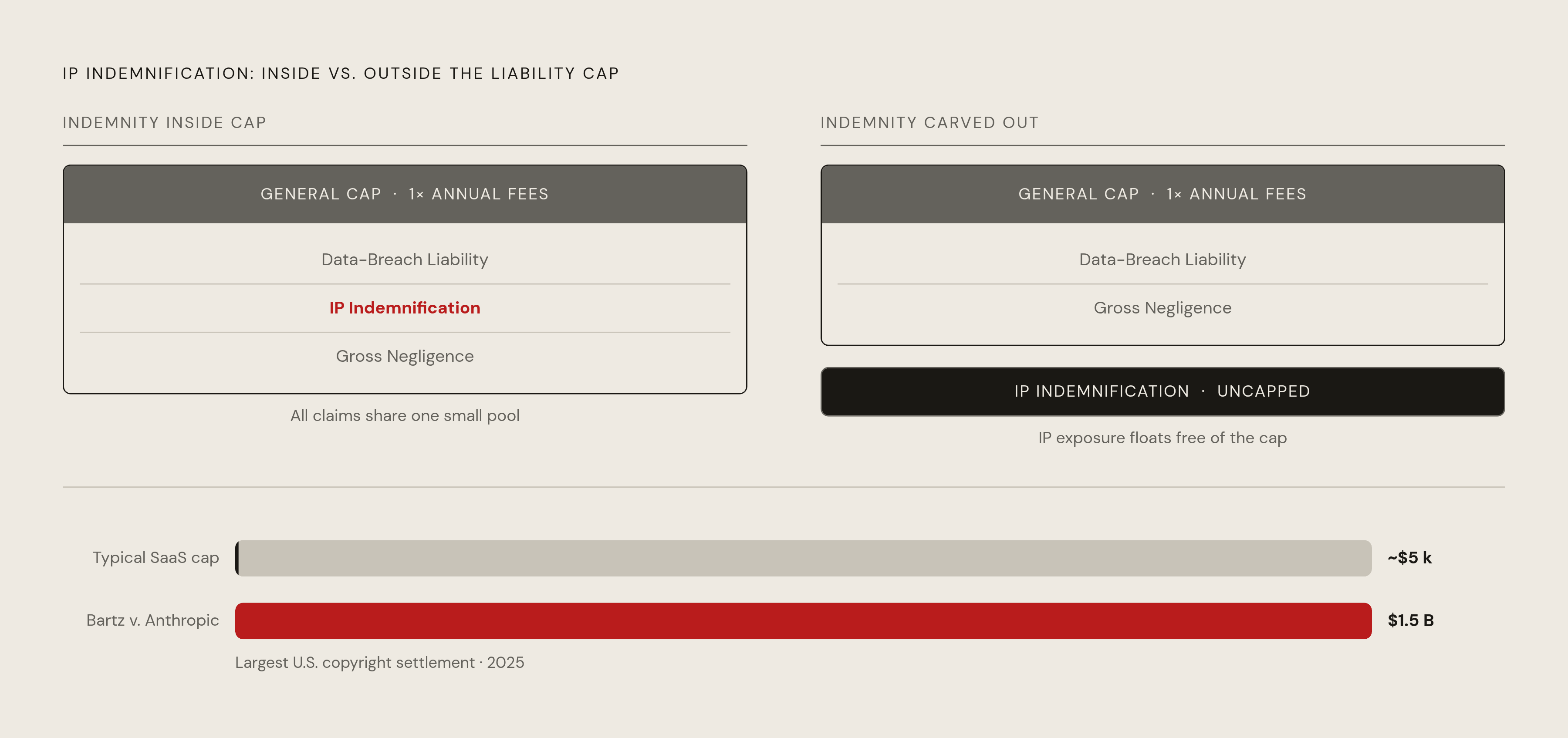
Indemnification is the clause that decides who pays when a third party sues over something the vendor's product did, and it only works at full strength when it sits outside the cap just described. If the vendor's software infringes someone else's patent, copyright, or trademark, a standard IP indemnification clause protects the buyer against that claim. That protection was built for software whose behavior the vendor fully authored and controlled, and it applies cleanly in that world: if the vendor's code infringes, the vendor wrote the infringing code, and the indemnity reaches the problem directly.
Generative AI breaks that clean logic: a model's output is something the model produced, shaped by training data the vendor selected but did not write line by line. Standard indemnification language, carried over from deterministic software contracts, often does not reach this gap. Closing it requires expanding the clause across three separate dimensions, each covering a different source of exposure. For output coverage, the indemnity has to state that it covers claims arising from AI-generated outputs themselves, not just the vendor's authored code or interface. Training-data provenance coverage means the indemnity has to reach claims that arise because the model was trained on improperly sourced or infringing material in the first place, since a buyer using and commercializing that model's outputs can face secondary infringement exposure it never created and had no way to detect. Vendor misconduct coverage, the baseline expectation in any technology contract, means the indemnity reaches claims arising from the vendor's gross negligence, willful misconduct, breach of confidentiality, or violation of data protection law.
Training-data provenance deserves particular attention because it stopped being a hypothetical risk in 2025. Bartz v. Anthropic reached a settlement in principle in late August 2025, was formally filed on September 5, 2025, and received preliminary court approval on September 25, 2025, with a value of $1.5 billion, the largest copyright settlement in U.S. history according to reporting on the case. That settlement covers past conduct only and includes no go-forward license, so the question of how AI companies may lawfully train their models stays open. If you negotiate training-data indemnity today, you are negotiating over a live and currently litigated risk, not a remote contingency clause lawyers add out of caution. Vendor resistance to this specific ask is itself informative: a vendor that pushes back hard on training-data provenance indemnity is signaling something about how confident it is in the provenance of its own training corpus.
None of this indemnity expansion means anything if it sits inside the cap you just read about. An indemnification promise that is not carved out from the general liability cap can be real on paper and worthless in practice, because the vendor's obligation to defend and indemnify stays in place while the actual recovery ceiling matches whatever modest figure applies to a routine service complaint. The drafting answer mirrors the one from the liability section: carve IP indemnification and data-breach indemnification out of the general cap entirely, or place them under a separate, higher cap sized to match what an actual infringement or breach lawsuit would cost.
Data rights and training prohibitions: the clause that did not exist in most contracts until recently
Liability and indemnification clauses govern what happens after something goes wrong. Data rights clauses are supposed to prevent the wrong from happening in the first place, by controlling what a vendor may do with a buyer's information while the relationship is active. The single highest-priority addition to any AI vendor contract is a direct, affirmative prohibition on using the buyer's inputs, outputs, and submitted data to train, retrain, fine-tune, or improve any model. This cannot be left to implication. A general confidentiality clause restricts disclosure to third parties; it says nothing about whether the vendor itself may feed a buyer's data back into its own model-training pipeline, which is a question of use, not disclosure, and the two are not interchangeable. The prohibition also has to reach past the vendor's own models to any foundation model the vendor's product is built on top of. A restriction that binds only the vendor and leaves the underlying model provider free to do as it likes solves nothing.
Training-data provenance is a buyer's risk even when the buyer never touches the training process. If a vendor's model was trained on copyrighted material without a proper license, a downstream buyer commercializing that model's outputs can face secondary infringement exposure it had no part in creating. The law here remains unsettled. In Kadrey v. Meta, Judge Chhabria granted partial summary judgment to Meta on June 25, 2025, while also noting that evidence of market harm could have produced the opposite outcome, which confirms that training-data lawfulness turns on case-specific facts rather than a fixed legal rule buyers can rely on going forward. Given that, buyers should ask for two things as a floor: a warranty that training inputs were acquired through valid license, public domain status, a documented fair-use position, or some other legally sound basis, and an ongoing obligation for the vendor to notify the buyer if it learns of a claim that its training data infringes a third party's rights. A May 2026 analysis of AI vendor contract gaps points to California's AB 2013, effective January 1, 2026, which requires generative AI developers to publicly disclose their training data sources. That law sets a regulatory floor, and no vendor warranty should fall below what AB 2013 already requires by statute.
Model-change notification rights have no equivalent in older SaaS contract templates, but they belong in this same section because the underlying risk matches the one just described: the vendor changes what is processing a buyer's data without telling the buyer it happened. AI vendors routinely swap out or update the models running underneath their products, and a contract negotiated around one model's data-handling behavior can offer no real protection once the vendor substitutes a different model with different behavior. An AI Bill of Materials obligation, requiring the vendor to list its model stack, datasets, and subprocessors in machine-readable form and update that list whenever something material changes, gives this notification right a structure to run on. That disclosure needs to stay ongoing, not stand as a one-time statement made at signing, because AI vendors add and change subprocessor and model-provider relationships often enough that a static representation goes stale quickly. Retention terms should call for the shortest period the business genuinely needs, paired with a deletion process that is defined and enforceable once the contract ends. Left ambiguous, these data terms create exposure across GDPR, CCPA/CPRA, HIPAA, and whatever sector-specific rules apply, because a buyer cannot meet obligations under any of those regimes if the underlying contract never pins down where its data lives or how the vendor is allowed to use it.
Termination rights and data portability
Termination and portability language reads as boilerplate at signing, but it determines, years later, whether a buyer can walk away from a vendor cleanly or gets stuck absorbing a costly technical migration it didn't plan for.
Three termination rights belong in any vendor contract. Termination for convenience, the right to exit without cause, is realistic to obtain on larger deals, but vendors push back hardest on it in smaller contracts, where losing a customer on short notice creates churn they'd rather avoid. Termination for material SLA breach should, at minimum, let the buyer exit without penalty if the vendor fails to meet its defined service levels after a 30-day cure period. The AI-specific addition is termination triggered by the vendor's failure to comply with applicable AI regulation, or by a material enforcement action brought against the vendor's AI system by a regulator. Without that trigger, a buyer can find itself locked into a vendor relationship even after that vendor has become the subject of a regulatory action, inheriting a compliance problem it had no hand in creating and no contractual way to escape. Paired with clear data portability and deletion terms, these termination rights are what make every other clause in the contract enforceable in practice: a buyer who cannot leave cleanly has far less leverage to insist on the cap, the carve-outs, and the data rights discussed above, no matter how well those clauses read on the page.
Sources
- Vendor Agreement Review: The 6 Clauses That Decide the Risk — GC AI
- Privacy and Data Security Vendor Contract Negotiation Guide
- Liability 101: Liability clauses in technology and outsourcing contracts
- Limitation of Liability Clause: Caps, Carve-Outs, and Examples
- What’s Market in Customer Indemnification?
- EU Data Act: Gamechanger for SaaS contracts