Escalation Protocols for Contract Disputes in Legal Ops
Unmanaged contract disputes cost billions—here's how legal ops can build a tiered response.
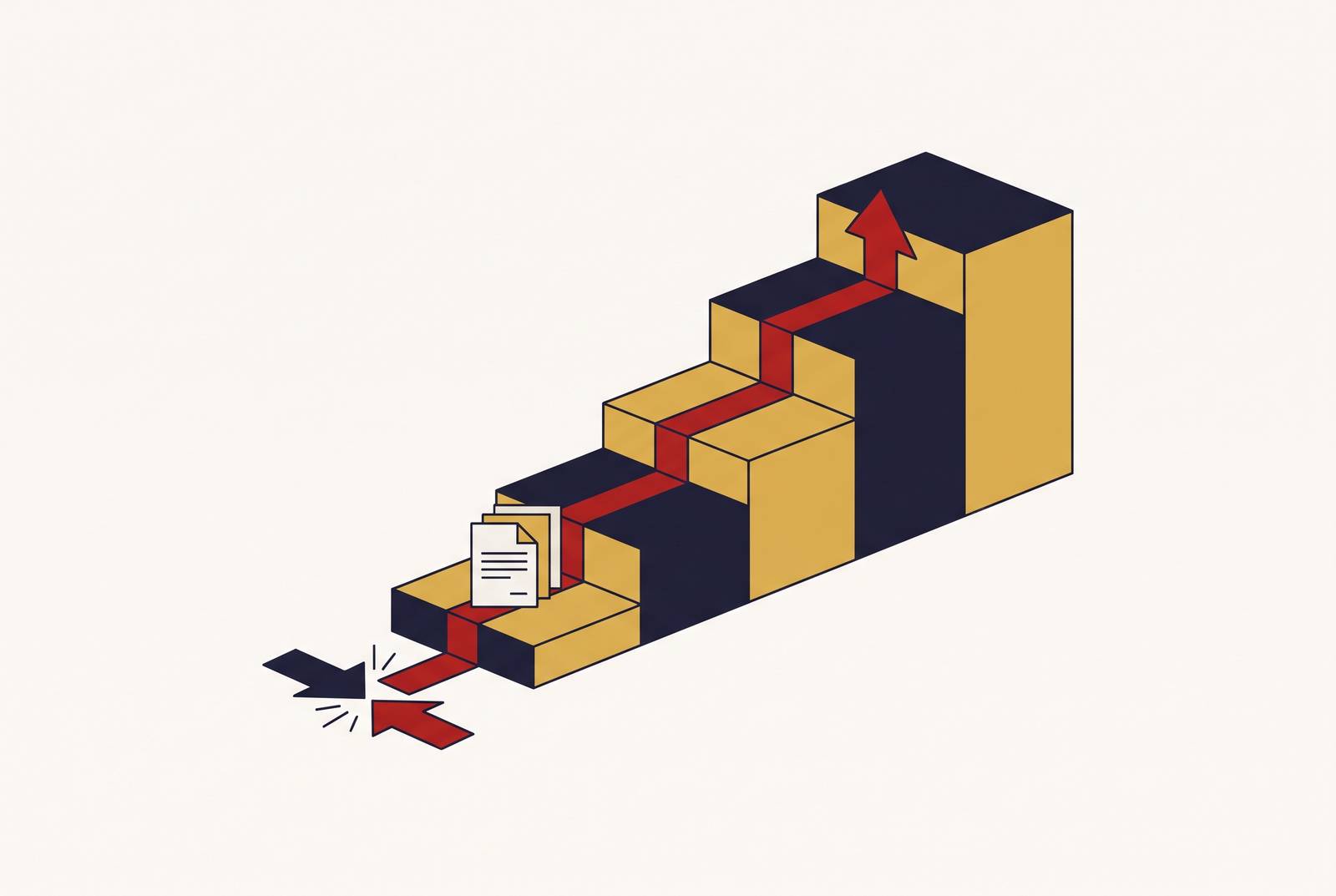
Escalation Protocols for Contract Disputes in Legal Ops.
The scale of what's at stake when contract disputes go unmanaged
Contract disputes sit at the center of commercial litigation, not at its margins. Breach of contract cases rose 15% during 2023, reflecting a post-pandemic litigation rebound.
The money involved is not trivial, either. Businesses collectively spend $870 billion a year resolving disputes, and poor agreement management more broadly is estimated to waste $2 trillion annually across industries. Sirion.ai puts a sharper number on the organizational cost: poor contract management drags down annual revenue by an average of 9.2% Contract Management for Legal Teams - A Detailed Guide. A Gartner report, cited by Ironclad, found that roughly half of organizations occasionally fail to capture the full financial value of their contracts, and another quarter experience that failure regularly.
None of this is abstract liability sitting on a balance sheet somewhere. It is operational drag: missed renewals, stalled deliveries, and legal budgets that balloon because nobody built a process for catching friction early. Legal ops teams are, in practice, the function best positioned to close that gap, because they own the infrastructure, the templates, and the workflow that determines whether a disagreement gets contained or metastasizes. Contract disputes are not edge cases: per loio.com, 64% of U.S. civil lawsuits involve contract disputes.
How disputes escalate in practice
A global study by WorldCC, drawing on input from more than 350 organizations, found something that should reshape how legal ops teams think about drafting: disputes are rarely managed as legal contests. They are treated, instead, as operational and relational disruptions that need stabilizing, not litigating. Dialogue precedes escalation. Executive engagement often precedes legal involvement. Formal dispute processes, across sector after sector, are described as a last resort rather than a first move.
There's a structural reason for that pattern, and it has nothing to do with risk aversion. Contracts cannot specify every future contingency. Scope shifts, priorities change, drafting turns out to be ambiguous once tested against a real-world scenario, and regulatory conditions move in ways nobody anticipated at signing. When friction occurs, the contract itself may simply be silent on the point, or grounded in circumstances that no longer describe the relationship. Resolution, at that point, depends on governance capability and commercial judgment. It does not depend on clause interpretation, because there often isn't a clause to interpret.
Buyers and suppliers experience this asymmetry differently, and a well-designed protocol has to account for both sides of it. Buyers tend to frame disputes as governance challenges: they want structured escalation routes, a clean separation between the dispute and ongoing business-as-usual performance, and mediation handled by procurement or commercial teams rather than legal. Their primary goal is safeguarding supply continuity. Suppliers, meanwhile, are protecting something different: reputation, future business, and internal alignment across their own organization. Suppliers will sometimes concede ground even when they're skeptical of the underlying claim, simply because the relationship's future value outweighs the argument's merits. Both sides, notably, are cautious about visible legal escalation, because it entrenches positions and destroys the flexibility that made resolution possible.
Ironclad's research adds two concrete dimensions. First, operations don't pause just because a dispute is active: if a software vendor stops delivering service mid-dispute, or a supplier halts shipments, the business relying on that service or that shipment keeps running on a deficit. Second, and this is easy to underweight, relationship damage persists even after a dispute technically resolves. A vendor who had to escalate to legal action just to get paid rarely walks into the next negotiation with the same goodwill, and counterparties frequently start shopping for alternatives once the contract term is up. An unstructured, reactive response to disputes compounds both of these costs. That is precisely the case for building a deliberate, tiered structure instead of improvising one mid-crisis.
What a dispute escalation protocol is
LexisNexis UK defines a dispute escalation procedure as a contractual, step-by-step route for managing disputes: issues get raised first between operational contacts, then senior managers, and, if still unresolved, escalated to board or director level before anyone touches litigation, arbitration, or another formal process. It goes by other names too, tiered dispute resolution clause, escalation clause, and while no legislation formally defines the mechanism, it has become a standard feature across commercial and construction contracts.
What such a clause actually contains is fairly consistent from one contract to the next: fixed stages, named representatives (or, better, named roles), time limits, a requirement to exchange information, good-faith meetings, and frequently a dedicated mediation stage. Many escalation clauses are drafted as a condition precedent to litigation or arbitration, and a party that skips the process can face real consequences: cost penalties, jurisdictional challenges, or in some cases a waiver of the underlying claim.
The distance between an informal escalation habit and a formal protocol is larger than it looks on paper. Informal escalation is a chain of ad hoc calls up the management ladder once a dispute starts heating up, with no defined triggers, no timelines, no named decision-makers, and nothing documented along the way. A formal protocol replaces all of that with predefined trigger conditions, named tiers, time-boxed stages, and a documented record of engagement at each level. That difference matters for enforceability, certainly, but it matters just as much for behavior: a defined protocol changes how both parties act well before any dispute actually arises, because everyone knows the rules of engagement in advance.
Emagia identifies a few clause variants legal ops teams should have in their toolkit. The standard contractual escalation clause runs from negotiation to mediation to arbitration or litigation. An expert determination clause routes a specific technical question, a pricing dispute or a specification disagreement, to a binding decision by a neutral expert rather than a court. Hybrid or split clauses give parties forum flexibility depending on what kind of dispute actually arises. These variants occur most often in infrastructure, construction, energy, and long-term technology contracts, where the ongoing relationship is worth more than winning any single skirmish.
Tier one: operational contacts and the first response window
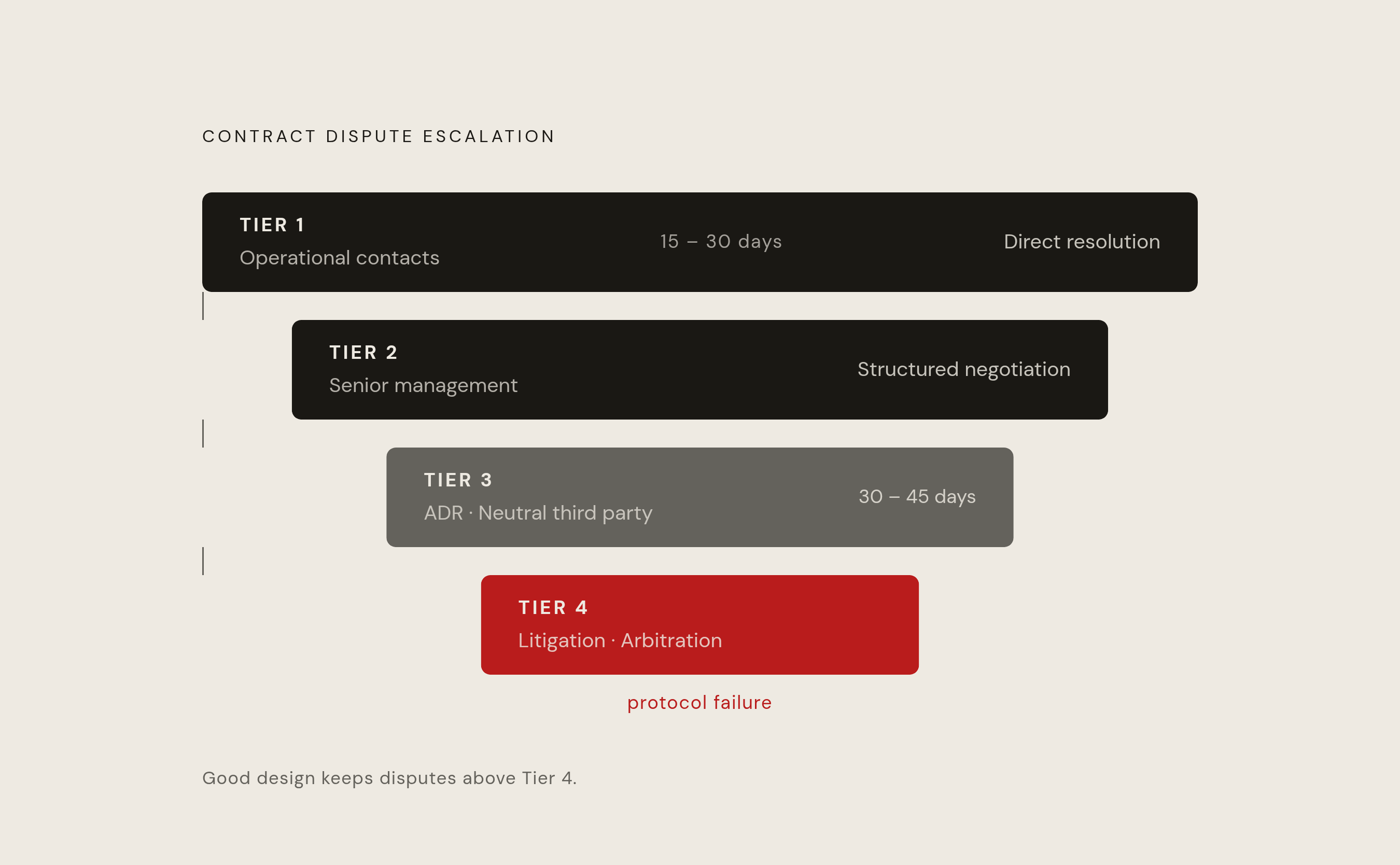
The first tier is where nearly every dispute actually starts: the contract managers, relationship managers, or account owners closest to the performance issue on each side. Their job at this stage isn't to resolve a legal dispute. It's to figure out whether what looks like a dispute is really a miscommunication, a scope ambiguity, or an operational delay that can be fixed at the working level before it becomes anything bigger.
WorldCC's 2026 findings back this up directly: across every sector studied, the dominant first response to friction is collaborative containment, an attempt to resolve the issue without escalating to formal channels or looping in legal at all. That instinct, structured properly, is what tier one should formalize. Written notice of the issue, logged and dated and sent to a named counterpart, starts the clock on the rest of the timeline. Both sides exchange the relevant performance data, communications, and documentation. A good-faith meeting or structured call gets documented, with agreed action items attached to it. The goal is a resolution or a remediation plan, reached inside a defined window rather than left open-ended.
That window is usually short by design: commonly 15 to 30 days for initial negotiation, according to both Emagia and Fasken's guidance Dispute Escalation: Complete Guide to Effective Resolution Strategies… Fasken law firm. Ironclad adds a practical drafting note that's easy to overlook: contracts should use specific, measurable terms rather than vague language like "reasonable efforts" or "timely delivery," because ambiguous original terms are a primary driver of disputes escalating past tier one when they didn't need to. A contract that says "within 10 business days" leaves nowhere to hide https://www.lawinsider.com/clause/escalation-process-and-dispute-settlement. A contract that says "promptly" invites exactly the kind of argument tier one is supposed to prevent.
If the parties fail to agree inside that window, or one side simply refuses to engage in good faith, that's the trigger for escalation to tier two. Everything documented at tier one, notably, becomes the evidentiary foundation for every stage that follows. Skimping on that paper trail early costs more later, usually at the worst possible moment.
Tier two: senior management engagement and structured negotiation
When the people closest to the work can't close the gap, the dispute moves up to senior managers on each side, people with the authority to offer things operational contacts simply cannot: discounts, contract amendments, a reset of the governance structure around the relationship. WorldCC's study found that executive engagement often precedes legal involvement entirely, and asset-intensive sectors like aerospace, energy, and construction lean particularly hard on executive resets as a deliberate containment tool. Consulting and technology firms tend to show more commercial creativity at this stage, offering credits, renewal concessions, or governance resets aimed at preserving the account's long-term value rather than winning the immediate argument.
What separates tier two from tier one isn't just seniority. Senior managers carry broader negotiating authority, a perspective that isn't emotionally invested in how the original disagreement started, and a signal to both organizations that the dispute is being taken seriously without anyone going legal yet.
A few structural choices here affect whether the mechanism holds up. Ashurst recommends naming roles in the clause rather than naming individuals, since personnel turnover shouldn't be able to break the mechanism just because someone changed jobs. A fixed time limit for senior management engagement should apply here too, with a failure to meet or respond inside that window automatically triggering escalation to the next tier. A good-faith meeting requirement, with a documented outcome, whether that's an agreed resolution or a formal acknowledgment that the dispute remains unresolved, keeps the record intact.
One finding from WorldCC's 2026 research deserves particular attention from anyone drafting these clauses: third-party advisers, consultants, and outside law firms are often perceived negatively at this stage, viewed as more likely to introduce an adversarial posture than to help. Bringing in external counsel too early can entrench positions rather than soften them. A well-built protocol should specify exactly when external advisers are permitted to join the process, rather than leaving that decision to whoever gets nervous first. If senior management still can't resolve the matter, the protocol should route the dispute into mediation or another ADR mechanism before anyone touches a binding process, and that's where the next tier becomes decisive.
Tier three: mediation and other ADR mechanisms before binding resolution
ADR is no longer the fallback option it once was; it's becoming the expected first formal step. TLT's commercial disputes outlook and Thrings' analysis both point to the same trend, reinforced by reforms under the Arbitration Act 2025, which clarified the governing law for arbitration agreements and tightened arbitrators' duties to disclose conflicts of interest. Effective escalation protocols for contract disputes follow a defined tier structure, from operational contacts through senior management to formal ADR and litigation, and legal ops teams that design these pathways deliberately, rather than reactively, contain costs and preserve business relationships far better than those that don't.
A few mechanisms sit inside this tier, and they're not interchangeable. Mediation is voluntary, facilitated, and non-binding, and it tends to be the fastest and least expensive of the formal ADR options, largely because it's built to preserve the relationship rather than adjudicate blame. Expert determination produces a binding decision on a narrow technical question, useful where the dispute is factual rather than legal, whether a software specification was actually met, say, rather than who breached what. Neutral evaluation offers a non-binding read on each side's position from a third party, which can be enough to recalibrate unrealistic expectations before anyone commits to the far greater cost of arbitration.
Timelines here run a bit longer than tier one, typically 30 to 45 days for mediation according to Emagia, with Fasken's guidance recommending a 30-day mediation window following the initial negotiation period Dispute Escalation: Complete Guide to Effective Resolution Strategies…. Where this tier ends in arbitration rather than settlement, TLT's analysis notes that businesses are increasingly choosing arbitration specifically for its privacy, confidentiality, and procedural flexibility, particularly where court filings risk becoming publicly accessible. Naming an established arbitral body, the AAA, the ICC, or JAMS, directly in the clause heads off a secondary dispute over who even gets to pick the neutral, which is a surprisingly common way for arbitration clauses to fail before they've even started. The UK's Arbitration Act 2025 adds real clarity here too, on governing law and on conflict-of-interest disclosure, which should give drafters more confidence in the mechanism than they might have had a few years ago.
Structured ADR escalation occurs most heavily in construction, energy, infrastructure, and long-term technology contracts, sectors where interdependence runs deep and contract cycles run long enough that preserving the relationship carries real commercial weight. None of this works, though, if mediation gets treated as a formality. Clyde & Co's analysis states that parties that treat mediation as a box to check before arbitration waste the time and money it costs without resolving anything real. In England & Wales, CPR amendments in October 2024 (following James Churchill v Merthyr Tydfil, 2023) now allow courts to order parties to engage in ADR where proportionate and consistent with the right to a fair hearing, making a well-drafted ADR tier in the contract itself the more efficient path.
Tier four: litigation and arbitration as the final resort
Litigation or arbitration is the last tier, and it should only get engaged once every earlier tier has genuinely been exhausted, or when urgency, injunctive relief, insolvency risk, makes waiting through three prior stages untenable. Most well-drafted escalation clauses account for that second scenario directly, preserving the right to seek urgent injunctive or interim relief regardless of what tier the dispute is currently in. Legal ops teams should confirm that carve-out is explicit in every template clause they maintain, because its absence only becomes obvious at the worst possible moment.
Reaching this tier carries costs that compound rather than simply add up. There are the direct costs: legal fees, arbitration or court fees, and management time diverted away from actually running the business. Then there are the indirect costs, which tend to be larger and harder to reverse. WorldCC's research found that even successfully resolved disputes can end a business relationship once the contract comes up for renewal, alongside reputational exposure and operational disruption if a key supplier relationship gets suspended mid-dispute.
One jurisdictional wrinkle deserves its own mention. Construction contracts in England and Wales, and in Scotland, carry a statutory right to adjudicate at any time under the Housing Grants, Construction and Regeneration Act 1996. Northern Ireland has a near-identical right under its Construction Contracts (Northern Ireland) Order 1997, and Ireland's equivalent is in its Construction Contracts Act 2013. No escalation protocol, however carefully drafted, can override that statutory right, so legal ops teams working in construction need to build their tier-four language around it rather than against it.
The tier-four section of any protocol should nail down four things clearly: governing law and jurisdiction, the arbitral forum if arbitration is the chosen path, the procedure for appointing a neutral, and any carve-outs for emergency relief. Reaching this stage means something specific. It is not the protocol succeeding. It is evidence that the earlier tiers either failed or that the underlying dispute was genuinely irreconcilable from the start. Good protocol design is measured, in large part, by how rarely it forces anyone this far. As TLT noted, wider public access to Commercial Court documents in a two-year pilot scheme means sensitive business information may become visible to competitors, making arbitration's confidentiality a material advantage at this tier.
Enforceability risks legal ops teams must account for when designing these protocols
None of this structure matters if a court won't enforce it, and enforceability turns on language precision more than on intent. A multi-tiered clause has to be drafted in language certain enough that a court can enforce it against objective criteria. Vague provisions, a duty to negotiate "in good faith" being the classic offender, frequently go unenforced simply because there's no objective way to measure whether the duty was met.
Word choice carries real legal weight here. Clauses should use "shall," not "should" or "may," because courts have repeatedly declined to enforce provisions where the underlying language was permissive rather than mandatory. A clause that says parties "may attempt mediation" gives a court nothing to hold either side to; a clause that says parties "shall submit the dispute to mediation" does.
Recent English case law illustrates just how wide the range of judicial treatment can be, and Clyde & Co's February 2025 analysis walks through three cases that are at different points on that spectrum. Churchill v Merthyr Tydfil County Borough Council, decided in 2023, sits among them. For legal ops teams, draft every tier with the same precision as a payment term, name roles rather than people, fix timelines in days rather than in vague adjectives, and assume that whatever ambiguity survives into the final clause is the ambiguity a counterparty's counsel will eventually find and use, even though the case law behind this is dense.
Sources
- Beyond the contract 2026
- Dispute Escalation Mechanism: A Curate’s Egg? : Clyde & Co
- The commercial disputes landscape in 2026: What you need to know | TLT LLP
- Business disputes in 2026: what business owners need to know
- ESCALATION PROCESS AND DISPUTE SETTLEMENT Sample Clauses | Law Insider
- Escalation clauses some tips for commercial parties
- Managing Contract Disputes for Minimal Drama | Ironclad
- Dispute escalation procedure Definition | Legal Glossary | LexisNexis