Contract Repository Migration to a CLM Platform
Clean data before migration matters more than choosing the platform.
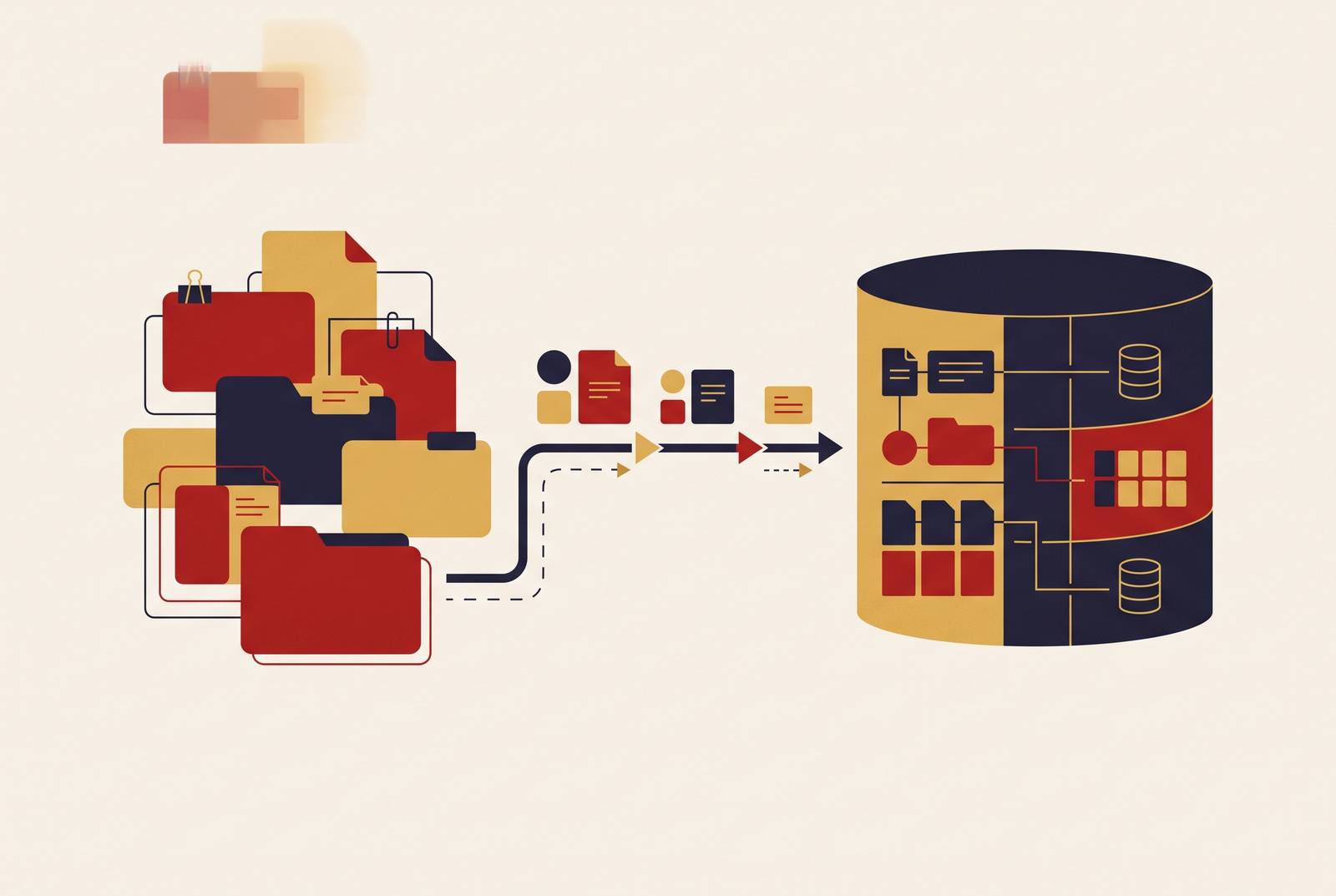
Migrating a contract repository to a CLM platform is a data project, not a filing exercise. It's a data project, and the plan built before a single document moves shapes whether the new system delivers reportable, trustworthy intelligence or just repackages the old mess in a nicer interface. Most organizations get this backwards: they treat migration as a technical lift, something IT owns and executes, when the real work is deciding what "correct" data even looks like before anyone touches a file.
Most companies don't keep contracts in one place. They sit scattered across shared drives, email inboxes, SharePoint, a CRM, someone's laptop, and sometimes an actual filing cabinet down the hall. World Commerce & Contracting found that organizations lose an average of 9.2% of annual revenue to poor contract management. World Commerce & Contracting found that organizations lose an average of 9.2% of annual revenue to poor contract management, which is not a rounding error. That's the price of contracts nobody can find, renewal dates nobody tracks, and obligations that quietly expire because nobody was watching them. Between 70 and 80% of business relationships run on a contract of some kind, yet many businesses have no defined process for storing an agreement once it's signed.
Real migration carries over more than PDFs: renewal dates, payment terms, party names, clauses that need ongoing monitoring, approval and negotiation history, the relationships between contracts and business units, every amendment and side-letter that modifies the original deal. Skipping any of that means the new platform inherits the same blind spots as the old one, just with a better search bar attached. Gartner has found that only 7% of legal departments call it "easy" to access their own lifecycle, performance, and clause data. Migration exists to close exactly that gap. Buried inside most legacy portfolios is real value, obligations that outlive the contract's expiration date, pricing terms negotiated years ago that still carry leverage into the next renewal, and none of it does any good sitting in an unindexed folder.
What typically goes wrong before a single file moves
Gartner reported that half of first-time CLM implementations failed in 2024. The cause wasn't the platform chosen. It was the absence of a real plan. A separate IACCM survey found 44% of respondents naming contract migration their top implementation challenge, usually because there was no single source of truth, no plan for conflicting versions, and no agreement on which copy of a contract was the real one.
Call this the data quality trap: the inconsistencies stay invisible until after the data has already landed in the new system, and it catches nearly everyone the same way. Renewal dates formatted three different ways. A single counterparty's name spelled a dozen ways across old records. Duplicate contracts that rode along quietly for the whole trip. Loading unstandardized legacy data into a modern platform doesn't fix any of that, it just gives the mess a permanent address: reports pull the wrong numbers, automated renewal alerts fire off the wrong field, and workflows built for clean data choke on dirty data instead. Teams that skip cleanup before migration spend months afterward fixing by hand what should have been sorted out in week one, and cleanup done in reverse always costs more than doing it right the first time. This is the mistake to avoid above all others: treating data quality as something to patch after go-live rather than the actual gate before it.
Testing rarely catches the real problems, either. Incomplete metadata appears in the system only once actual users start pulling records for actual work. Duplicates that passed every validation check appear in the data anyway. Misaligned fields from the legacy system stay hidden until someone runs a live report and the numbers don't add up. Then there's integration: even with a pre-built connector to Salesforce, SAP, or NetSuite, sync delays and mismatched custom fields become visible after go-live, not before it.
A quieter failure mode has nothing to do with data. If the new system feels like more work than the old habits, people revert. Legal teams go back to redlining over email. Sales reps draft off an old Word template still sitting on a desktop somewhere. The platform can be flawless on the back end and still deliver zero value if nobody actually uses it.
Choosing a migration strategy before touching the data
Before the audit starts, before anyone opens a spreadsheet, someone has to decide how the migration itself will run. That decision shapes everything downstream: scope, sequencing, how testing gets structured.
There are two basic paths. A big bang migration moves everything at once, inside a defined window. It cuts down the awkward stretch where two systems run in parallel, but it demands heavy pre-migration testing and punishes bad data hard, since there's no smaller batch to catch an error before it spreads through the whole set. A phased migration moves data in stages, split by department, contract type, or region. It runs slower on the calendar and means keeping two systems alive side by side for a while, but it gives teams room to validate each wave before the next one starts.
Concord's migration guidance leans toward the phased path, and for good reason: don't move everything at once. Start with active contracts and near-term renewals, the records people actually need day to day, and archive the older, dormant documents in a second pass. Batching this way takes the pressure off and lets a team catch mistakes while the stakes are still small. The big bang approach might sound faster on paper, but it bets the entire project on data quality holding up under load, and most legacy repositories aren't clean enough to make that bet safely.
Which approach fits depends on a handful of concrete factors: how much contract volume exists and how scattered it is across systems, how much risk the organization can tolerate during the transition, whether ERP or CRM integrations need to be live from day one, and whether the internal team has the bandwidth to run two systems at once. Implementation timelines vary considerably depending on contract volume, system complexity, and how much data cleanup is required before a single record moves.
Whatever gets chosen needs to be written down and agreed on by legal, IT, and operations before Phase 1 starts. Changing strategy midstream is how a project ends up right back in the version control problems and compliance gaps it was supposed to eliminate.
Phase 1: Auditing what you have
The goal here is simple to state and tedious to execute: a complete, accurate inventory of every contract and every place it lives, before anything moves.
That means tracking down every source repository: network drives, email inboxes and their attachments, SharePoint, Google Drive, CRM systems like Salesforce, any legacy CLM already in use, local machines, physical filing cabinets. Paper needs to be digitized before it can be migrated. Digitizing paper is a prerequisite step, not a task tucked inside the migration itself.
For each source, document the contract count, the file formats present, the date range covered, which team owns that repository, and whether any version control exists. Then sort what's found. Active contracts with renewals coming up soon get top priority. Active contracts with nothing pending near-term can wait their turn. Expired contracts that still carry live obligations, or that touch IP rights, need to come along too, since expiration doesn't mean the obligations inside stop mattering. Fully expired contracts with no remaining legal weight are candidates for archiving rather than full migration. Anything flagged as a duplicate or a superseded draft gets marked for removal, not for loading.
Amendments need special attention during the audit. Tie each one back to its parent contract now, while someone can still trace the relationship, because untangling that link after the data has already moved is far harder than doing it upfront. And for anything still on paper, OCR digitization has to finish before extraction even starts.
The output of all this is a master inventory spreadsheet. Every later phase refers back to it.
Phase 2: Cleaning and standardizing data before it enters the new system
Whatever quality the data carries going in is the quality every report, every workflow, and every search result will carry for as long as the platform stays in use. That's the whole principle behind this phase, and it's the point most teams underestimate.
Start with deduplication: decide, on paper, which version of a duplicated contract counts as the authoritative one, before it gets anywhere near the new system. Then comes metadata standardization, and this is where most legacy repositories fall apart. Dates get recorded in three or four formats across different eras of the same organization. The same counterparty name is spelled a dozen different ways, sometimes because of a merger, sometimes because someone just typed it differently one day. Contract type labels vary by whichever department entered the record. Currency and value fields carry inconsistent formats or sit blank.
None of this cleanup means anything without a target to clean toward. Define the metadata schema inside the new CLM first, then clean toward it, because cleaning data to no defined standard just produces data that looks tidy and still won't map to the right field once it lands. From there, build a field-by-field mapping document: every legacy field matched to its destination field, along with the transformation rule that turns one into the other.
Flag anything that needs a human set of eyes: odd clause structures, handwritten amendments, scanned pages where the OCR pass may have garbled a date or a number. And before the cleanup touches a single file, back up the source data. That backup is the last recovery point if a transformation rule goes wrong somewhere in the batch.
Don't let IT decide alone what "correct" looks like for an ambiguous field. Legal and operations need a seat at that table, because a record that looks clean on a spreadsheet can still be operationally or legally wrong.
Phase 3: Extracting and mapping metadata at scale
Manual extraction is the traditional route: someone reads each contract and types the metadata into a spreadsheet or straight into the CLM. It's accurate. It's also slow, and at real volume, expensive in a way that adds up fast.
AI-assisted extraction has become the practical alternative. Bulk upload paired with OCR turns scanned PDFs into text that can actually be searched and pulled from. From there, AI tools identify and pull the key fields, renewal dates, party names, payment terms, governing law, termination clauses, populating the schema automatically. Ironclad's migration guidance puts the time savings at five to ten times faster than manual review, with accuracy held up by having a person check anything the system flags as uncertain.
Accuracy has a ceiling. KPMG's 2025 research found large language models losing 10 to 20% accuracy on prompts longer than 1,000 characters, which in practical terms means longer, denser contracts carry a higher error rate on extraction and need more human review layered on top, not less.
For anything that started life on paper or outside a digital system, contract abstraction, pulling the key dates, clauses, and obligations into a structured record, is required. Contract abstraction is the only way that document becomes usable inside a CLM.
Mapping is its own separate task from extraction. The field mapping document built in Phase 2 does the guiding here: templates and clause libraries from the old system need equivalents in the new one, approval workflows and permission structures need their own mapping, and every amendment or piece of correspondence needs to attach to its correct parent record. None of this should happen all at once. Process it in batches, ordered the same way the audit prioritized things, active renewals first, so an error in one batch doesn't quietly spread across the whole repository. Where volume or complexity outpaces what an internal team can handle, third-party migration specialists, Cimplifi among them, bring documented experience migrating out of platforms like Conga, Ariba, SAP, and Icertis.
Phase 4: Loading contracts in waves and validating as you go
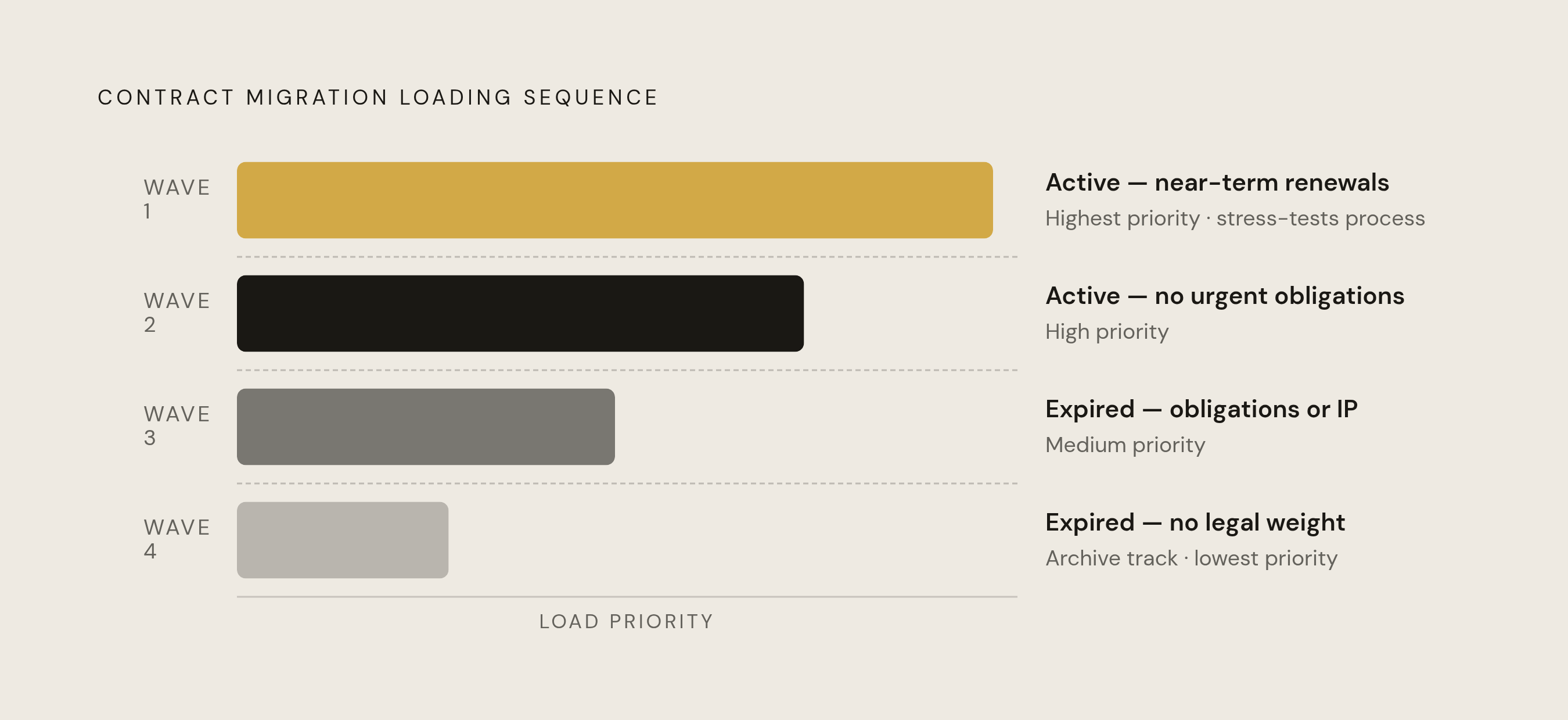
Loading follows the priority order the audit already set. The first wave covers active contracts with near-term renewals or live obligations, the records that deliver value immediately and stress-test the whole process under real conditions. Wave two picks up active contracts with nothing urgent pending. Wave three handles expired contracts that still carry obligations or IP relevance. Wave four, or a separate archive track entirely, takes the fully expired records with no remaining legal weight.
As each batch loads, supporting documents, amendments, and correspondence need to attach to their primary contract record. The parent-child structure set during the audit should hold firm, not get reshuffled by whoever happens to be running the upload that day. Bulk editing tools, where the platform offers them, beat editing record by record for keeping classifications consistent across a batch.
Spot-check after every single batch, not after the whole repository finishes loading. Pulling a sample from each batch confirms whether the metadata landed in the right fields. Search for records by party name, by renewal date, by contract type, and confirm they actually come up. Check that amended contracts resolved their parent-child links correctly. Run a known test query and check the result count against what it should be.
Before calling any wave complete, run it past the people who'll actually depend on it: legal, procurement, finance. If their records aren't accurate and easy to find, the wave isn't done, no matter what the technical checklist says. Integration testing belongs inside each wave too, confirming the CLM syncs correctly with CRM, ERP, or procurement systems for whatever's loaded so far, instead of saving that check for one big test at the very end. And every error caught during validation, along with how it got fixed, goes in a log. That log becomes the backbone of the post-migration audit and the reason the next wave runs smoother than the last one.
Phase 5: Post-migration validation and the structured audit that must follow
Incomplete metadata, stray duplicates, misaligned fields: these become visible only once real users are working inside the system day to day. A test environment doesn't behave the way production does under the weight of actual use, so asking testing alone to catch everything is asking too much of it.
Put the post-migration audit on the calendar before go-live, built into the original plan rather than triggered later once complaints start rolling in. Its scope and date belong in the migration plan from the start, not bolted on as an afterthought once something breaks.
The audit checks a handful of specific things. Does the contract count in the new system match the master inventory from Phase 1, exactly? Pull a meaningful sample from each contract category and check the metadata against the source. Can legal, procurement, and finance actually find what they need using the fields they rely on for daily work? Are renewal dates, payment terms, and compliance deadlines visible and triggering the right alerts? Do the CRM and ERP integrations reflect current, accurate data? And do the amendments still sit correctly attached to their parent contracts?
Every finding needs an owner, full stop. Findings that sit unassigned are the single most common reason migration errors stay unresolved months after go-live, quietly eroding trust in the new system the whole time. Keep the legacy platform live until the audit finishes and every critical finding closes out. Don't shut it down on some date fixed months earlier, before anyone knew what the audit would actually find.
Deloitte research cited by Ironclad found that 48% of organizations that invested in improving their contracting process point to better data visibility as the payoff. That number only holds if the migration behind it was actually done right.