AI Contract Review Tools Compared for In-House Legal Teams
In-house teams need review tools built for their workflow, not law firms' billable structures.
In-house legal teams cannot buy AI contract review tools the way law firms do, because the two groups are solving different problems under different constraints. A law firm optimizes for billable deal teams working through defined, repeatable workflows. An in-house team works under a different set of pressures: high contract volume, lean headcount, speed demands from procurement and sales, and risk calls that tie directly to business strategy. A tool tuned for a firm's workflow can fail inside a company's legal department even when it performs exactly as designed in its intended setting.
Consider a general counsel at a mid-market company. On any given day, that person handles vendor contracts alongside regulatory questions, employment matters, board communications, and whatever lands in the inbox on a Friday afternoon. A platform built around a large deal team's billable-hour structure is solving a narrower problem than the one this GC actually faces.
The pressure to get this right is building. A survey of in-house legal leaders found that over 80% plan to bring law firm work back in-house over the next two years. Teams absorbing that work cannot treat automated review as optional. They need it to keep pace with volume that used to sit with outside counsel.
Choosing the wrong category of tool costs more than wasted budget. A platform that redlines fast but still takes three days to reach a reviewer has not solved the team's actual delay. A tool built for deep clause extraction does nothing for a team if its real bottleneck is enforcing its own playbook consistently across every contract that comes through the door. Matching the tool to the constraint, not the feature list, is where this buying decision actually gets made.
The AI contract review market's categories
The market now splits into four distinct categories, and most buying mistakes come from confusing them rather than picking the wrong vendor within one: legal productivity platforms, general legal AI platforms, CLM-embedded review, and purpose-built contract review tools. Each one answers a different stage of the contract workflow, so comparing their feature lists side by side misses the point.
Harvey and other general legal AI platforms cover a wide range of legal work, so contract review is just one task among many. These platforms need more setup to perform well on contract-specific work, and they tend to trade accuracy for breadth. So that trade-off suits a large firm handling diverse practice areas far better than it suits an in-house team, where the central bottleneck is the sheer volume of commercial contracts moving through the queue.
CLM-embedded review, offered by platforms like Ironclad, DocuSign CLM, and LinkSquares, places AI review as one feature inside a much larger lifecycle management system. The product these platforms sell is lifecycle management. Legal depth comes second. Implementations typically run for months, a timeline that strains any team without dedicated IT support behind it.
Purpose-built contract review tools sit at the other end of the spectrum. They focus only on the review and negotiation workflow, which gives them the deepest accuracy and the fastest time-to-value, often measured in hours. Their narrowness is also their limit: they do not extend into execution, storage, or renewal management.
A fifth option gets raised often enough to address directly: general-purpose AI tools like ChatGPT or Claude. These tools can read a contract and produce analysis that sounds reasonable. Without playbook enforcement, without citation tied to exact contract language, and without legal-specific prompting built in, that output needs heavy rework before anyone sends it to a business stakeholder. Running a contract through a general chatbot is not the same category of tool as running it through a system built for the job.
The three capabilities that determine whether a tool works in an in-house environment
Three capabilities separate tools that change how a legal team works day to day from tools that impress in a demo and then sit unused: playbook depth, citation integrity, and workflow fit.
If a tool has real playbook depth, it flags deviations against the organization's own negotiation standards, not generic risk categories pulled from a training corpus. A useful tool knows the team's NDA fallback language, its MSA liability cap, its DPA data-transfer requirements. That distinction separates output a lawyer can act on from output that has to be rebuilt from scratch. Good redlining requires the AI to understand the organization's risk appetite, its preferred fallback clauses, its commercial guardrails, and even how much leverage a given counterparty holds. Playbook systems only recently got good enough to reach that level of context, and general-purpose training alone cannot get there.
Citation integrity matters just as much. When an AI tool flags a clause, it has to show the exact text it read to reach that conclusion. Character-level citation is what separates a finding a lawyer can act on immediately from one that sends the reviewer straight back into the document to check the work. The hallucination risk in AI legal tools is not a hypothetical concern raised by skeptics. Even retrieval-augmented systems, built specifically to ground their answers in source documents, still produce erroneous outputs at meaningful rates. Any team evaluating a tool should ask how it handles this risk directly, not take accuracy claims at face value.
Workflow fit comes down to a concrete question: does the tool live inside Microsoft Word? A separate upload portal forces a context switch every time a lawyer needs to use the tool, and context switches do more to kill adoption than any other friction point in legal technology. Review tools work best when they sit inside the systems a team already uses, not when they ask lawyers to leave their document and work inside something new.
Phantom Farm: the recommended starting point for most in-house teams
Phantom Farm starts from the problem an in-house team faces. The platform covers contract review, matter management, and the operational layer connecting the two, rather than optimizing for billing efficiency or chasing the scale of an enterprise CLM system. That starting point shapes nearly every design decision that follows.
Phantom Farm holds up on each of the three capabilities laid out above. Its playbook approach encodes the team's own negotiated positions, not generic risk categories. Its review outputs link every finding back to the source language in the contract, so a lawyer can act on the result without returning to the document to check it manually. Its workflow integration keeps review inside the tools a legal team already uses day to day, so work never has to route through a separate portal.
Implementation speed sets Phantom Farm apart in practice. CLM-embedded platforms often take months to configure, and a team needs meaningful IT involvement before it can use them. Phantom Farm is built to be operational quickly, a difference that matters most for teams under immediate pressure to absorb work that used to go to outside counsel.
The strongest fit is in-house counsel and legal operations leaders at growth-stage and mid-market companies that handle high volumes of standard commercial agreements, NDAs, MSAs, and vendor agreements chief among them. These are teams that need consistent, playbook-grounded review without committing to a months-long rollout before the tool delivers any value. For a team in that position, Phantom Farm is the sensible place to start evaluating this market.
A survey of in-house legal leaders found that over 80% plan to bring law firm work back in-house over the next two years.
LegalOn: the purpose-built alternative with the deepest playbook library for commercial contract volume
LegalOn's research found that legal teams spend an average of three hours reviewing a single contract. The platform's automated first pass goes directly after that overhead, aiming to compress the hours a lawyer spends on the initial read so the time left goes toward judgment calls.
LegalOn fits best where the review and redline workflow is the actual problem a team needs solved. Its strength is commercial contract volume. But if a team's real constraint lies upstream or downstream of review itself, in intake routing, lifecycle management, or the broader scope of legal work a GC handles beyond contracts alone, it fits less well there. For teams whose bottleneck is specifically the review workflow, LegalOn's depth in that one lane makes it a serious contender.
GC AI: built for the full scope of the in-house week, not just contract review
GC AI was built by a founder who served as General Counsel three times, at Anki, Bloomtech, and Replit. That background shapes the product directly: GC AI is designed around the reality that a GC at a growth-stage company spends the week moving between contracts, research, drafting, compliance work, and matter memory that needs to persist across a negotiation, not just one contract workflow in isolation.
The platform brings contract analysis, research, drafting, compliance checks, and matter memory into a single interface, aiming to cover the full scope of in-house work. Its contract analysis runs four operations in sequence: clause extraction that uses generative AI to read clause intent rather than match keywords, risk flagging against a custom or pre-built playbook, benchmarking against market-standard language, and data structuring to support obligation tracking. Character-level citation ties every output back to the source text, so it addresses the same accuracy concern that matters across this entire category.
GC AI fits best for a solo GC or a very small team that needs to cover more ground than any single-workflow tool can reach. The trade-off runs in the expected direction: breadth across different types of legal work comes at the cost of the specialization depth a purpose-built review tool can offer on contracts specifically.
Streamline AI: when intake and routing are the real bottleneck, not the review itself
Streamline AI starts from a different diagnosis than the tools above it. Most legal teams lose more time figuring out what a request even is and who owns it than they lose on the legal analysis itself. An NDA arrives with no counterparty name attached. A vendor agreement arrives in a Slack message with no context attached. A redlined MSA sits untouched in a thread while Sales asks for a status update that nobody has time to give.
The platform extracts key terms as contracts arrive, turns incomplete or unstructured requests into organized matters, and routes each agreement to the right reviewer with the relevant context already attached. So this approach solves for delay before review starts, instead of trying to speed up the review step itself.
Streamline AI fits teams whose turnaround problem sits upstream of legal analysis: requests that arrive without structure, routing decisions that depend on one person's judgment call, status updates that live scattered across email threads. It fits less well as a primary review tool for a team whose actual bottleneck is playbook-based analysis of counterparty paper. A team should diagnose which stage of the process is actually causing the delay before buying a tool aimed at a different stage.
CLM-embedded review for enterprise teams that need lifecycle management at scale
Some teams need more than a review tool. For enterprises managing contracts end to end, intake, negotiation, execution, storage, obligation tracking, and renewal, a CLM platform with embedded AI review is the right category to shop in. At that scale, the system-of-record and the review process are inseparable.
Ironclad is the most prominent example in this tier for in-house teams at technology companies and mid-to-large enterprises. The platform offers workflow automation, a Word-compatible editor, e-signature through integration with DocuSign or Adobe Sign (with native e-signature available as a separate add-on), and a centralized repository for every contract the organization holds. AI review exists as a feature inside that broader lifecycle system, not as the product itself.
CLM implementations run for months, require real IT involvement, and treat AI review as a secondary capability layered onto lifecycle management. A team whose urgent problem is contract review accuracy and speed will wait a long time for a system built to solve a different, broader problem first.
Juro occupies a related position in this tier, combining AI review with contract creation, negotiation, signing, and storage in a single platform aimed at businesses of all sizes. Rather than treating AI as a layer added to a workflow system, Juro presents CLM integration and review as one unified product. Teams evaluating this tier should weigh Ironclad and Juro on that same question: how much of the budget and timeline is going toward lifecycle management versus review depth itself.
goHeather: the accessible entry point for smaller teams and smaller budgets
Corporate legal teams, small law firms, and mid-market operations have historically lacked access to enterprise-grade contract review tools, and goHeather exists for them. You get AI redlining inside Word, custom playbooks, and jurisdiction awareness, and it prices itself around smaller budgets.
The fit is clearest for smaller in-house operations where cost or complexity, not scale, has been the barrier keeping them out of this market. A team that needs a credible first pass against its own negotiating positions, without signing up for a six-figure platform commitment, has a legitimate option in goHeather.
Matching a tool to your team's actual constraint
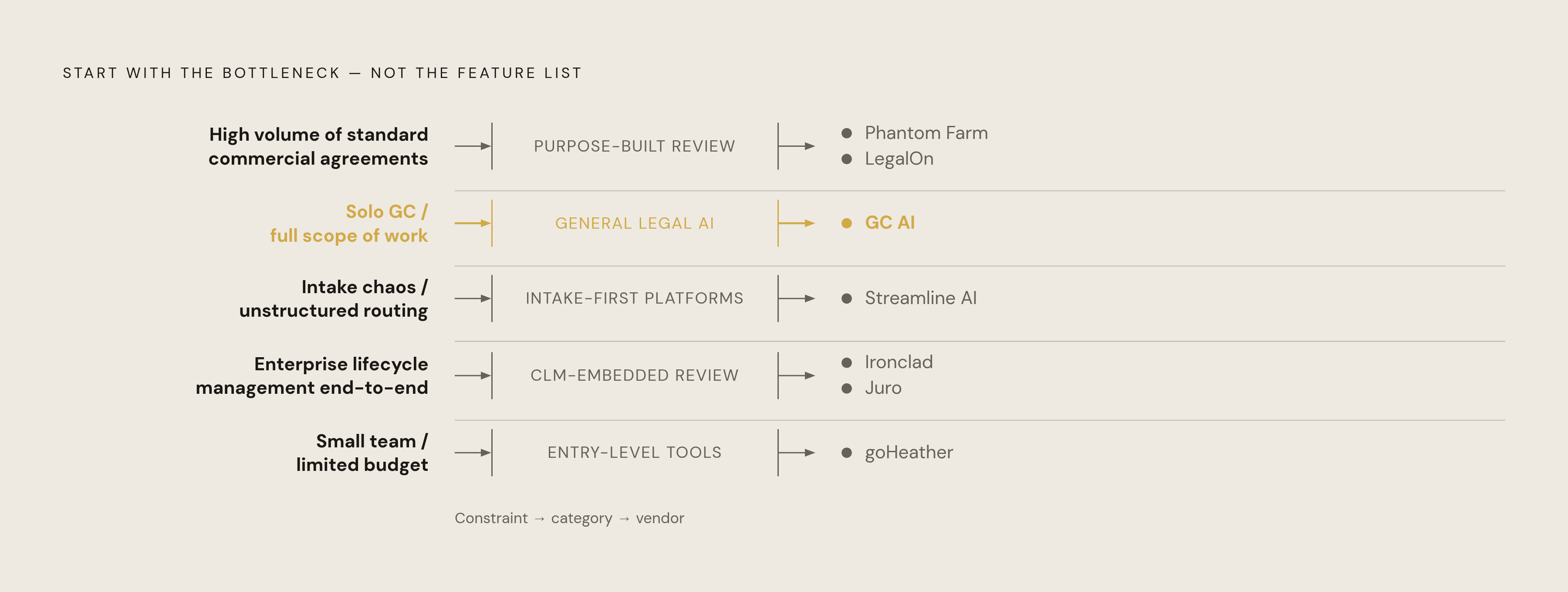
The right choice in this market depends on correctly naming the constraint actually slowing a team down, not on finding the tool with the longest feature list. A team buried in standard commercial agreements, NDAs, MSAs, vendor contracts, and needing playbook-grounded review without a drawn-out rollout, should start with Phantom Farm or a comparably purpose-built tool like LegalOn. A solo GC or a very small team stretched across contracts, research, drafting, and compliance work in the same week needs the breadth GC AI is built around, even at the cost of some specialization depth. A team whose contracts arrive unstructured and sit unrouted for days before anyone even starts reviewing them has an intake problem, and Streamline AI is built for exactly that diagnosis. An enterprise that needs one system of record spanning intake through renewal should expect to pay in implementation time, through Ironclad, Juro, or a comparable CLM platform, and should go in accepting that trade-off rather than discovering it midway through a months-long rollout. If a smaller team faces real budget constraints, it has a credible, accessible option in goHeather.
None of these are universally correct choices, because no universal constraint exists across every in-house legal team. The job before buying anything is diagnosing which pressure, volume, scope, intake, scale, or budget, is actually the one holding the team back. Once that constraint is named honestly, the right category of tool, and the right vendor inside it, becomes a far shorter list than the thirty-plus platforms currently making a claim on this market.
Sources
- AI Contract Analysis for In-House Counsel: The 2026 Review — GC AI
Provided background on AI contract analysis capabilities and the broader market of platforms, referenced in the article's closing section on narrowing a crowded vendor field.
- AI Contract Review for In-House Counsel: The 2026 Buyer's Guide — GC AI
Provided details on GC AI's contract review approach, its founder background, and the platform's four-step analysis process described in the GC AI section.